
Sewage in your yard: what it usually is (and isn't)
Surface sewage panics most homeowners into picturing a full system rebuild. Two-thirds of the time it isn't that. Here's the diagnostic walk-through.
Reading time: about 9 minutes · Updated May 21, 2026
Sewage surfacing in a Hancock County yard has four common causes, with very different price tags. From cheapest to most expensive: a broken inlet elbow at the field ($150–$500), a clogged or failed distribution box ($600–$1,800), a saturated drainfield from a wet season or overloaded household ($0 to thousands, depending on cause), and full drainfield biomat failure requiring rebuild ($8,000–$20,000). The diagnostic steps below help you place your situation before you spend money.
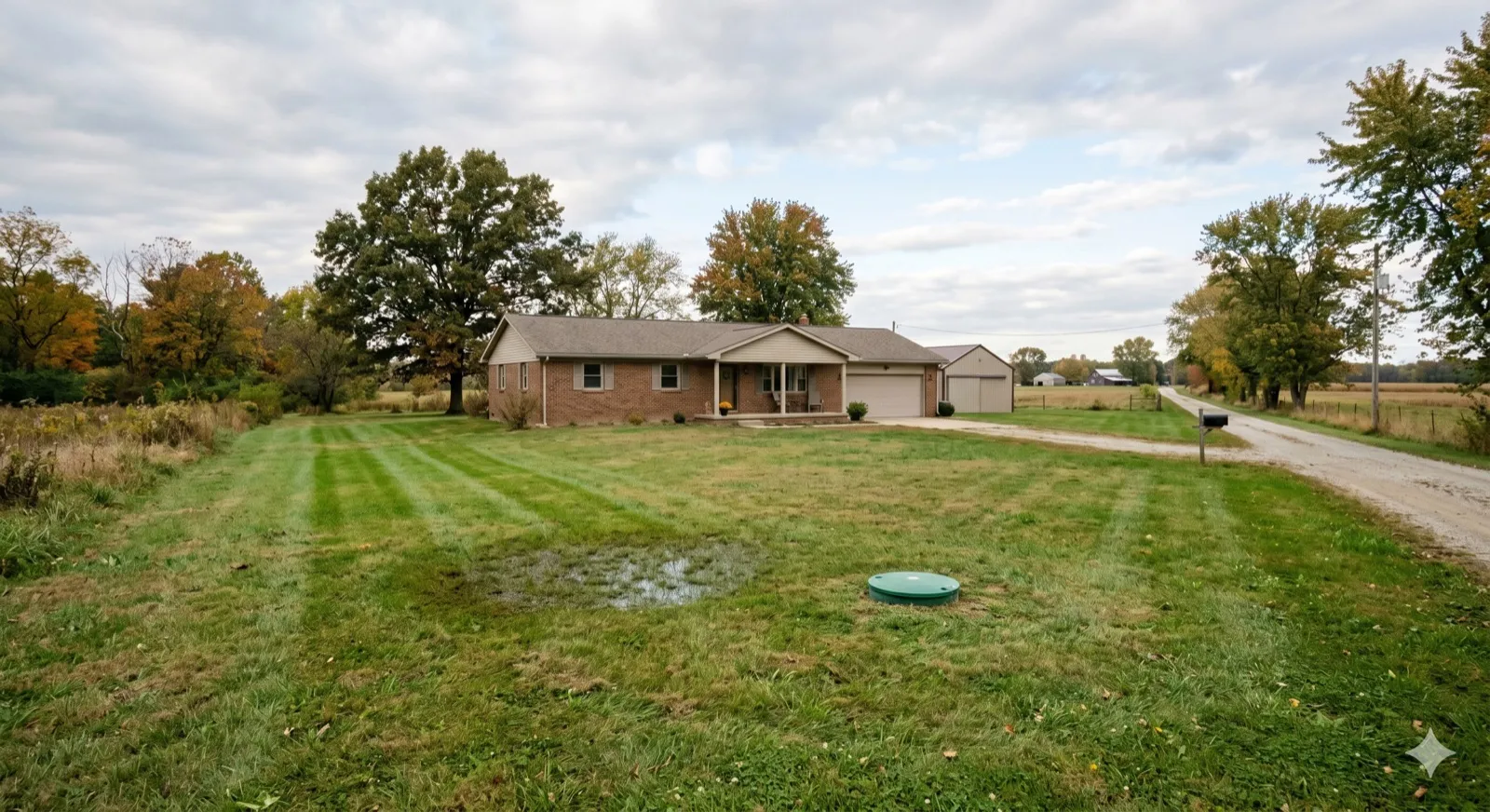
- How close to the tank the wet spot is — the first diagnostic
- Cause 1: broken inlet elbow or pipe ($150–$500)
- Cause 2: clogged or failed distribution box ($600–$1,800)
- Cause 3: saturated drainfield (often temporary)
- Cause 4: genuine drainfield failure ($8,000–$20,000)
- A quick homeowner triage walk
- What a good written diagnosis looks like
First: how close to the tank is the wet spot?
The single most useful piece of information is where the surfacing is relative to the tank. Sewage breaking through the soil directly between the tank and the drain field — within ten or fifteen feet of the outlet baffle — almost always points to the cheapest category of problem. A broken inlet elbow, a settled distribution box, or a collapsed section of pipe between the tank and the field will all surface in that narrow strip of yard. These are repairable in a half day for $150 to $1,800 depending on what's broken.
Sewage surfacing out over the drain field laterals — the long parallel strips of slightly different grass, usually thirty to eighty feet from the tank — is a different conversation. That's where the field is either temporarily saturated (from a wet season, a stuck running toilet, or a recent house guest spike) or genuinely failing (biomat fouling, soil compaction, or end of useful life). Same surface symptom, very different cost ranges.
Cause 1 — Broken inlet elbow or pipe between tank and field
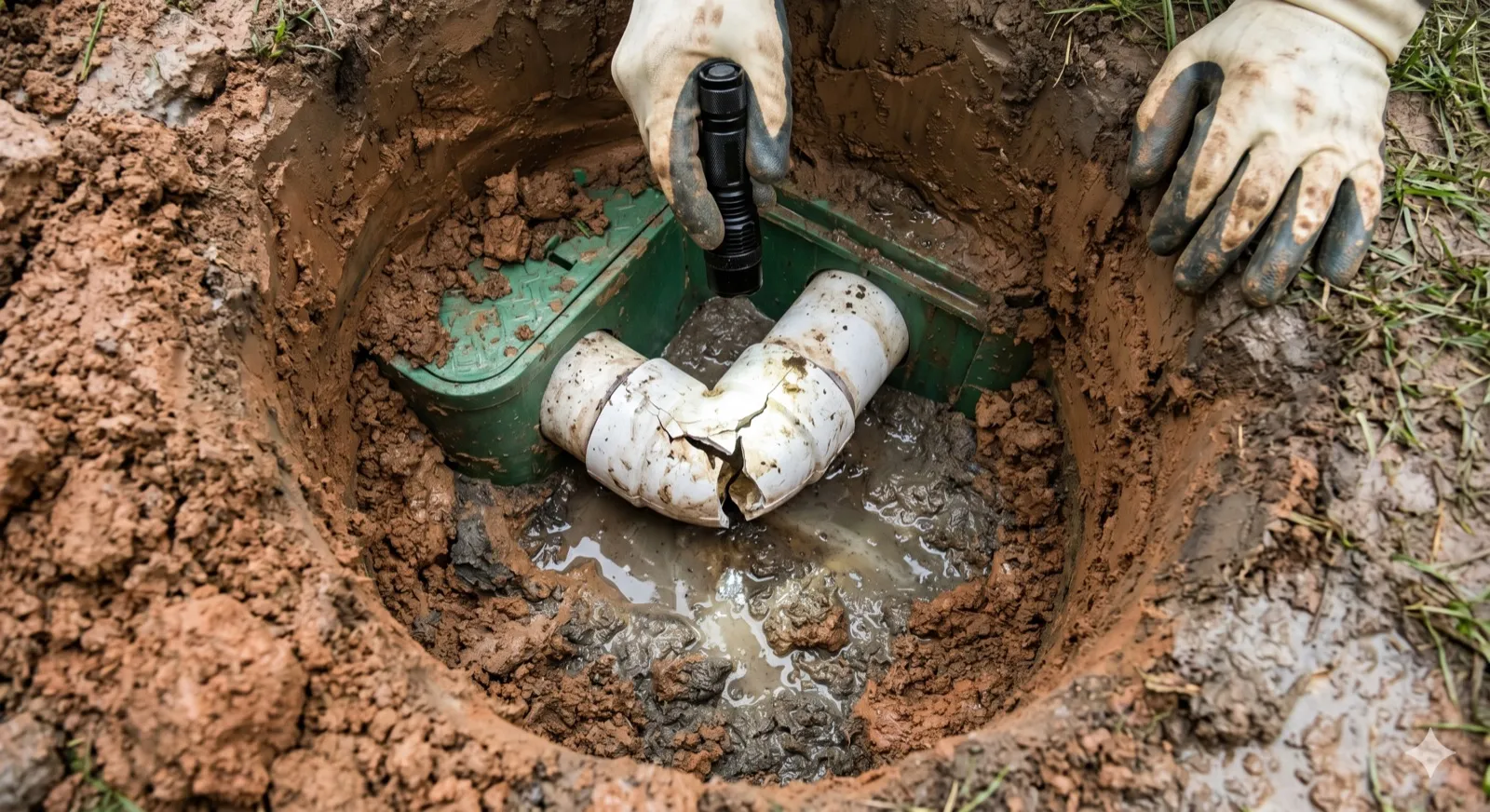
The inlet elbow is the PVC fitting that drops effluent from the tank outlet down into the distribution box. It's a sacrificial part that cracks from settling, root pressure, or just age. When it goes, raw effluent fountains out of the broken joint instead of being split across the laterals — and you get a localized wet patch right between the tank and the field.
What it looks like: a circle of saturated, sewage-smelling ground a few feet across, well upstream of the lateral lines. The rest of the drainfield looks normal. The toilets don't gurgle. Slow drains aren't the main complaint.
The fix is excavation down to the joint, replacement of the elbow, and refill. Half a day, $150 to $500 total. No permit required under 410 IAC 6-8.3 — this is repair, not modification.
Cause 2 — Clogged or failed distribution box
The distribution box (D-box) sits just past the tank and splits effluent evenly across the field's lateral pipes. When it clogs with settled solids, or when it settles unevenly on its concrete bed, flow stops being distributed — one lateral gets all the load and the rest go dry. The overloaded lateral surfaces; the dry ones don't.
What it looks like: surfacing concentrated above one or two of the lateral runs (often the shortest or lowest-elevation lateral, because gravity tilts toward it), while the rest of the field stays dry. The grass over the unused laterals goes off-color from lack of moisture. A common giveaway in Hancock County is a single bright-green stripe surrounded by lawn that's the right color for the season.
The fix is locating the D-box (usually with a probe or beacon locator), pumping it clean, and either re-leveling it on its base or replacing it with a new box and adjustable speed-leveler. Most repairs run $600 to $1,800 depending on access and whether the box has to come out. Again no permit — this is maintenance.
The reason this matters: many Hancock County homeowners get quoted $15,000 to $20,000 for "drain field replacement" when the actual problem is a $1,200 D-box repair. Always demand a written diagnosis identifying the failed component before agreeing to a full rebuild. The upsell-scams guide covers what that diagnosis should look like.
Cause 3 — Saturated drainfield (temporary)
A temporarily saturated drainfield is the most common cause of surfacing in central Indiana — and the most overdiagnosed as "failure." The clay-heavy glacial-till soil under most of Hancock County simply doesn't drain fast during prolonged wet periods. After a week of spring rain or a fall storm cycle, the soil column under the laterals is already at field capacity. Anything the household puts into the system sits on top of saturated soil and works its way to the surface.
What it looks like: surfacing across the whole field roughly evenly, worst in a low spot, that gets noticeably better within a few days of the rain stopping. Toilets may run a little slow during the wettest stretch but recover. The system handled the dry season fine.
The fix is usually "reduce water input and wait." A leaky toilet (running unnoticed in a guest bathroom) doubles household water use and is the single most common avoidable cause of perceived field failure — replace the flapper for $5 and the surfacing often resolves. Reducing laundry loads to one a day during wet weeks, fixing dripping faucets, and putting off the dishwasher to evenings spreads the load. If the field is intermittently saturated every wet season but recovers in dry months, you almost certainly don't need a rebuild.
The case for a curtain drain (a shallow trench upslope of the field that intercepts groundwater) shows up when the field is wet for reasons unrelated to household use — usually a high water table or surface runoff from a neighboring property. The clay-soil drainage guide gets specific about when curtain drains help and when they don't.
Cause 4 — Genuine drainfield failure (rebuild)
A genuinely failed drainfield is the expensive case — and it's the one homeowners imagine first when they see anything wet in the yard. The actual signature is more specific: surfacing that doesn't resolve with dry weather, persistent sewage smell that doesn't dry out, the lowest fixture in the house backing up consistently, and often a history of years past the field's design life.
Conventional Hancock County drainfields are designed for 20–30 years of service. Properties built before 1990 with original systems are candidates by age alone. Heavy household use over decades shortens the timeline; older systems sized for two-person households that eventually housed five or six adults wear out earlier.
The mechanism is biomat fouling. Over time, anaerobic bacteria build up on the soil interface where the lateral pipes meet the trench gravel. A thin biomat is actually helpful — it filters effluent before soil absorption. A thick, mature biomat seals the soil interface and the field stops absorbing. There's no homeowner-level repair; the field gets dug out and rebuilt with new gravel, new laterals, and (usually) a new distribution box.
Full drainfield rebuild in Hancock County runs $8,000 to $20,000 depending on soil scientist requirements, site access, and whether the tank also needs replacing. The permit process through the Hancock County Health Department adds about $250–$400 and roughly six to eight weeks of timeline. The permit-delay survival guide covers how to manage the gap.
A quick homeowner triage walk
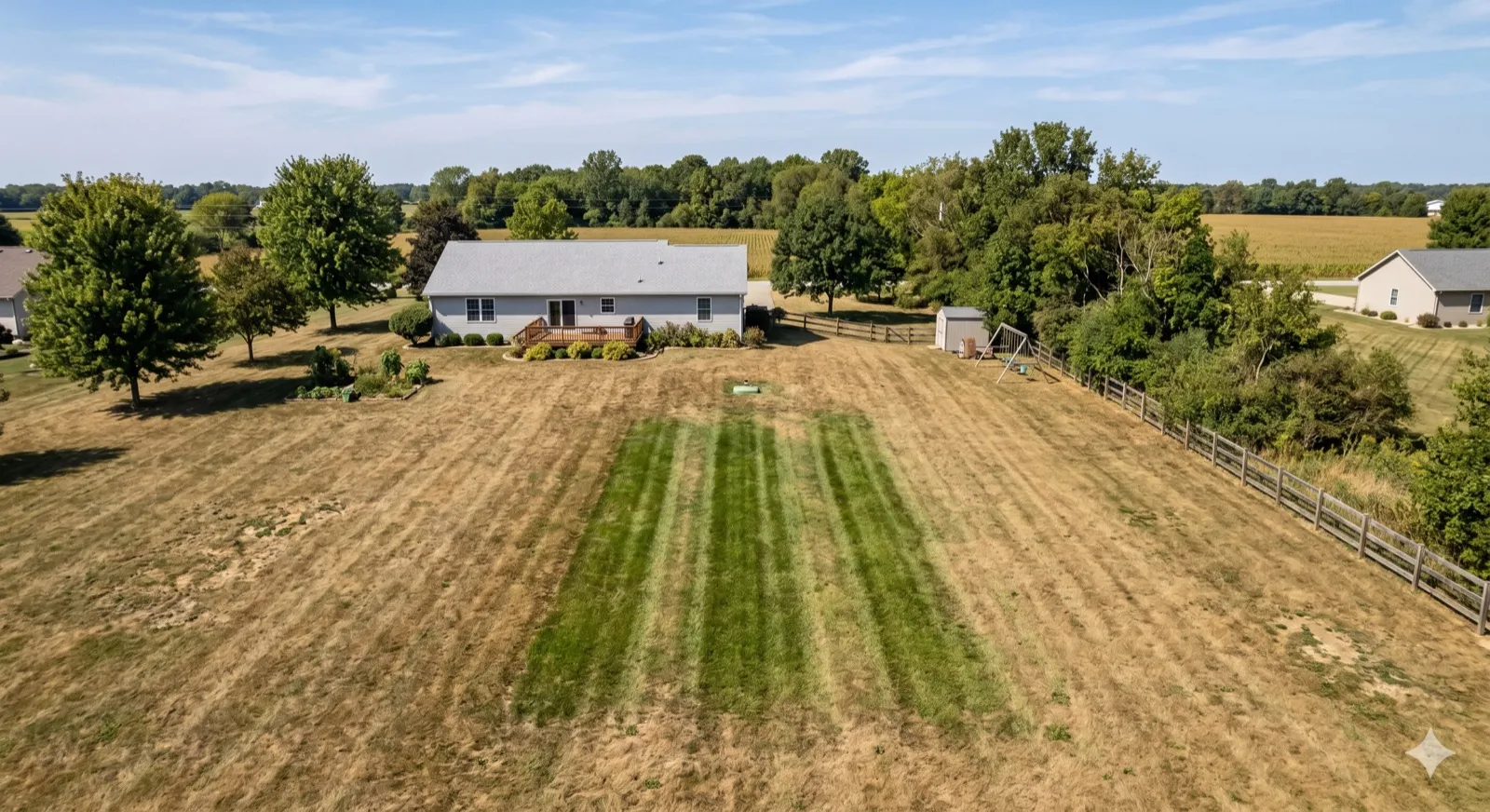
Before any pro shows up, here's a five-minute walk that often identifies the cause:
- Find your riser. Walk out to the green or black riser lid in the lawn. Note where it is relative to the wet spot. Wet spot within 10–15 feet, between tank and field? Likely Cause 1 or 2.
- Map the laterals. Lateral lines usually run as parallel slightly-different-color stripes downhill from the tank. Wet spot over one stripe while the others are normal? Likely Cause 2 (D-box). Wet across all stripes? Cause 3 or 4.
- Check the toilets. Walk every bathroom. Lift each tank lid and listen for running water. A running flapper in a rarely-used guest bath is a classic Cause 3 trigger.
- Check the calendar. When was the last pump-out? If it's been over five years, the tank itself may be backing up solids into the outlet — which surfaces near the tank like Cause 1 but is fixed by pumping, not digging.
- Check the weather log. Is the surfacing tied to recent heavy rain? Cause 3 (saturation) is the heavy favorite if so. The heavy-rain backup guide goes deeper on the rain-correlation signal.
Photograph the wet spot from a few angles before any pro arrives. The progression of how a surface symptom evolves over a day or two is often more diagnostic than a single visit.
What a good diagnosis looks like in writing
Any honest septic operator should give you a written diagnosis that identifies the specific failed component, the test or observation that confirmed it, and the proposed repair scope. Vague "your field is failing, $18,000 to replace" without a component-level diagnosis is the upsell pattern, not a real diagnosis.
We write our diagnoses with the failure mode named (e.g., "outlet elbow cracked at upper joint, distribution box not reached"), the evidence (photos of the elbow, dye-test results, sludge-depth measurements), and a fixed-price quote for the repair. If a rebuild is genuinely the answer, the soil-scientist evaluation under 410 IAC 6-8.3 has to come first — and the proposal should explain why.
See surfacing right now?
Call (317) 836-2464. We'll talk through what you're seeing before anyone schedules a truck. Mon–Sat, 7 a.m.–6 p.m. — Adam answers.
Related: soggy yard in Indiana clay · tank backing up after heavy rain · full Hancock County septic guide