
Soggy yard in Indiana clay: drainage problem or failing drain field?
Both surface the same way. They have different fixes, different contractors, and different price tags. Read the pattern before paying either.
Reading time: about 10 minutes · Updated May 21, 2026
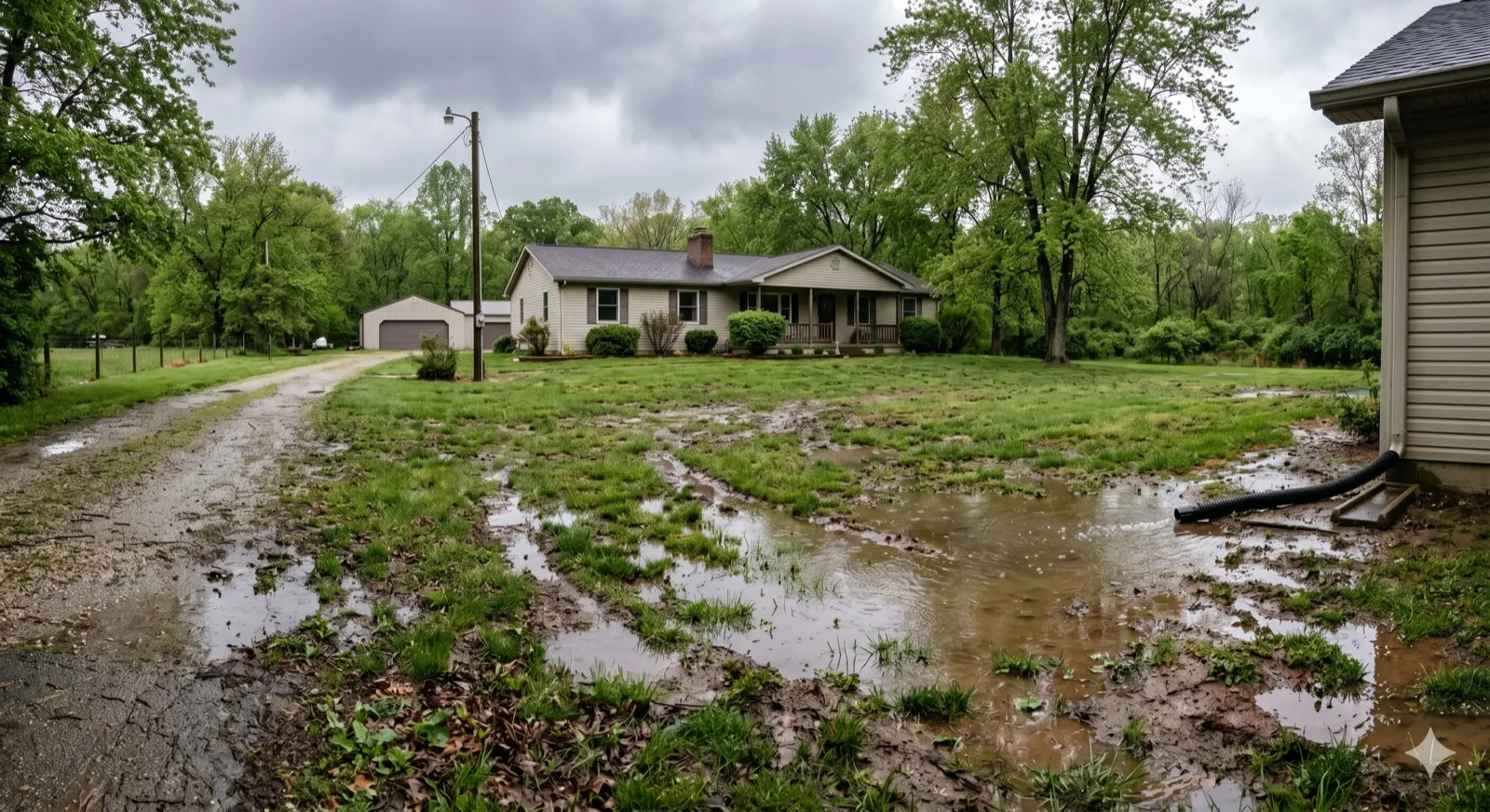
Hancock County's glacial-till clay drains poorly by nature — a soggy yard in central Indiana can be a drainage issue (grading, downspouts, high water table) or a septic field failure, and the surface symptoms look identical. The diagnostic is location and smell: a drainage problem is anywhere on the property, doesn't smell, and tracks with rain events; a septic problem sits over the drain field laterals, often has a faint sewage smell, and may not fully recover between rains. Knowing which one you have determines whether to call a drainage contractor ($1,500–$5,000) or a septic operator ($600–$20,000) — and getting that backward wastes both budgets.
- Why Hancock County yards are wet in the first place
- Signature of a drainage problem (not septic)
- Signature of a septic problem
- The tricky middle case — both at once
- A 15-minute diagnostic walk
- Grade considerations for new and existing systems
Why Hancock County yards are wet in the first place
Hancock County sits on a thick layer of Wisconsin-glaciation till — a clay-dominant glacial deposit several feet deep over most of the county. The Vernon Township uplands around Fortville and McCordsville run heavy clay; the Brandywine Creek and Sugar Creek bottoms have looser silt loams; pockets of the Mt. Comfort / US-40 corridor sit on mixed glacial outwash. None of these drain quickly.
The percolation rates that licensed soil scientists measure for septic permits under 410 IAC 6-8.3 reflect this — Hancock County fields are typically designed larger than equivalent fields in sandier states because the clay can't absorb effluent as fast. The same clay that constrains septic design also constrains general yard drainage. When water can't move down through the soil column, it sits on top or runs sideways looking for a low point.
That means a lot of Hancock County yards are wet for reasons that have nothing to do with the septic system. Telling the two apart is the diagnostic challenge.
Signature of a drainage problem (not septic)
Marks of a drainage-only issue:
- Location. The wet area is at a low point in the yard, in a swale, next to the foundation, or downhill from a downspout discharge — not sitting over the drain field laterals.
- No smell. Wet without sewage odor. Slight musty earth smell is normal.
- Rain correlation is tight. Wet within hours of significant rain, gradually dries over 2–7 days depending on rain volume and sun exposure.
- Pattern matches surface flow. If you walk uphill, you can usually see where the water comes from — a neighboring property's gutter system, a paved area without proper grading, a swale that dead-ends at the wet spot.
- Septic system normal. No backups, no gurgling, no slow drains. The household is using the system unremarkably and the wet area shows up regardless.
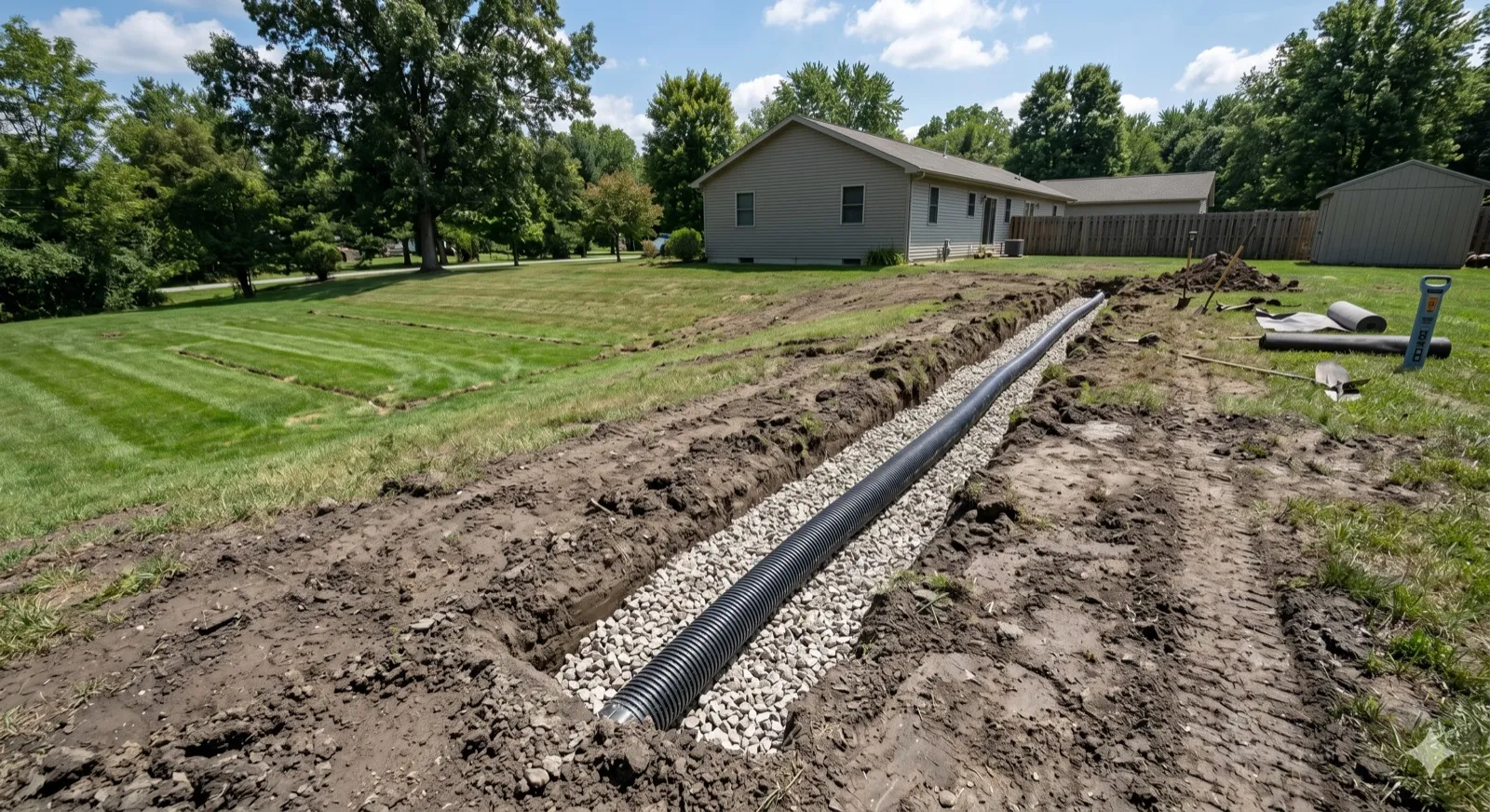
Typical fixes: regrading the affected area to direct water away ($500–$2,500); extending downspouts to discharge further from the house ($150–$400); installing a French drain or perforated drain tile to move water to a lower release point ($2,000–$5,000); installing a curtain drain to intercept upslope groundwater ($3,000–$5,000). All of these are general landscape drainage work — a septic operator isn't the right contractor.
Signature of a septic problem
Marks of a septic-system issue:
- Location. The wet area sits directly over the drain field laterals — usually a series of parallel strips of slightly different grass color, 30–80 feet from the tank, running downhill. Or it sits between the tank and the field (cause of upstream component failure — see the sewage in your yard guide).
- Smell. Faint or strong sewage smell over the wet area. Even in dry weather, residual smell hangs on a few days.
- Grass behavior. Bright-green stripes over the laterals during dry weather (effluent fertilizing the surface) is a tell-tale septic sign even when the surface isn't visibly wet.
- Household correlation. Wet area gets worse after heavy household use — laundry day, houseguests, holiday cooking. A drainage problem doesn't notice the dishwasher; a septic problem does.
- Slow indoor recovery. Slow drains, gurgling, lowest-fixture backup tendencies during the wet stretches.
Typical fixes depend on the specific failure mode — D-box repair ($600–$1,800), partial lateral replacement ($1,500–$5,000), or full drainfield rebuild ($8,000–$20,000). The sewage in your yard diagnostic walks through which one applies.
The tricky middle case — both
The case that fools homeowners most often: a working septic field that's being overwhelmed by groundwater from outside the system. The field itself isn't failing — it's structurally sound, the biomat is normal, the laterals are intact — but groundwater is reaching the trenches from upslope or from a rising seasonal water table, saturating the soil column under the laterals before the household effluent even arrives.
What it looks like: a yard that's wet over the drain field and shows surface drainage patterns from neighboring properties or higher ground. Both signatures present at once. Septic surface symptoms (smell, bright green grass) are sometimes present, sometimes not.
The fix isn't full field replacement. It's a curtain drain — a shallow trench filled with gravel and perforated pipe, installed upslope of the drain field, that intercepts groundwater and routes it around the field to a release point downhill. Cost is typically $3,000–$5,000 depending on length and terrain. The drain field itself doesn't need work. A soil scientist evaluation under 410 IAC 6-8.3 can confirm whether the wetness is groundwater-driven (no rebuild required, curtain drain is the fix) or biomat-driven (field rebuild required regardless).
The signal to look for: the field is wet during periods without household use. If the household is on vacation for a week and the field is still wet during a rainy stretch, the water isn't coming from the system. Curtain drain.
A diagnostic walk for clay-soil yards

Take 15 minutes after the next significant rain:
- Map the wet spot. Photograph it from multiple angles, note its dimensions, and locate it relative to the riser lid in the lawn (which marks the tank position).
- Smell test. Squat down and smell at the wet edge. Sewage smell is septic; earthy musty is drainage.
- Walk uphill. Trace where surface water is flowing from. If you see clear surface flow into the wet spot from an uphill source (neighbor's downspout, gravel driveway runoff, an unmaintained swale), that's drainage signal.
- Look for the laterals. Drain field laterals usually leave a visible signature — parallel strips of slightly greener (or sometimes browner) grass running away from the tank. If the wet spot sits over one or more of these stripes, that's septic signal.
- Note the household pattern. Does the wet spot get worse on laundry days? After dinner-party nights? That's septic. Does it stay constant regardless? That's drainage.
- Check the indoor symptoms. Any slow drains, gurgling toilets, faint sewer smells in low-elevation rooms? That's septic.
Two or three of the septic markers and zero drainage markers points you to call a septic operator. The reverse points you to a drainage contractor. Mixed signals are the curtain-drain middle case, and a soil scientist evaluation is the next spend.
Grade considerations for new and existing systems
On new installations, the licensed soil scientist evaluation under 410 IAC 6-8.3 is supposed to catch clay-related drainage issues before the system is sited. The evaluation looks at seasonal high-water-table depth, percolation rate, and surface drainage. Done right, the system gets placed where the soil column can actually handle it, with grading that directs surface water away.
On existing systems — particularly Hancock County houses built in the 1970s and 1980s — the original grading often hasn't been maintained. Subsequent landscaping, deck additions, sheds, gravel driveways, and grading changes by previous owners can divert surface water toward the drainfield rather than away from it. That's the most common avoidable cause of "field saturation" calls. Pulling back the regrading and restoring the original positive slope away from the field laterals fixes more "failing" fields than people realize.
When a septic operator walks the field and recommends regrading before rebuild, that's usually a good sign — they're trying to solve the cheap version first. Operators who skip to "the field is done, $18,000 to rebuild" without examining the surface grade are the ones to question. See the upsell-scams guide.
Wet spot in your Hancock County yard?
Call (317) 836-2464. We'll walk through it with you before sending a truck — sometimes the answer is "call a drainage contractor first." Mon–Sat, 7 a.m.–6 p.m.
Related: sewage in your yard diagnostic · tank backing up after heavy rain · full Hancock County septic guide