
How to spot septic upsell scams from national chains
The five-figure quote on a thousand-dollar problem is a pattern, not a coincidence. Here's how to tell.
Reading time: about 10 minutes · Updated May 21, 2026
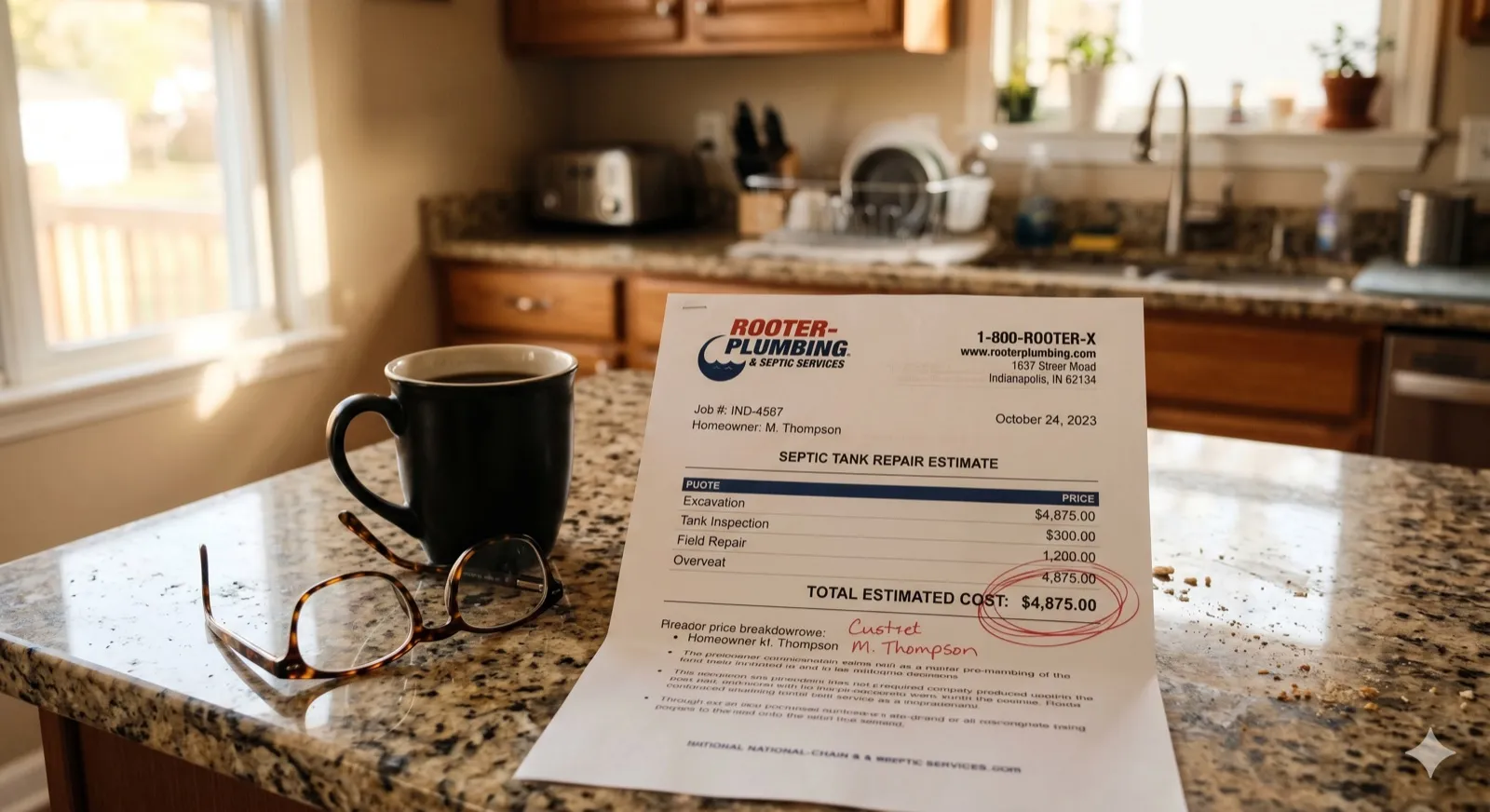
Common septic upsell patterns in Indiana include the $4,000 "field treatment" sold after a routine pump-out, the panic-quote on a tank that's only overdue (not failing), the made-up distribution box repair, and the "we'll replace the whole field for $15,000" pitch when the actual problem is a $300 elbow joint. The defensive moves are: demand a written component-level diagnosis before paying for any major work, ask which specific component is failing and what evidence confirmed it, refuse same-day pressure on jobs over $1,000, and get a second opinion from a local licensed operator before signing anything for $5,000+. None of those are unreasonable. Honest operators expect them.
- Why this happens at scale
- Pattern 1: the "field treatment" upsell
- Pattern 2: the panic-quote on a tank that's only overdue
- Pattern 3: the made-up distribution box repair
- Pattern 4: "we'll replace the whole field"
- What an honest written diagnosis looks like
- How to get a clean second opinion
Why this happens at scale

National-chain plumbing brands (Roto-Rooter, Mr. Rooter, Benjamin Franklin, and others) run on a franchise model where the local franchisee is heavily incentivized on revenue per ticket. The dispatch system, the truck SOP, and the script the tech runs all favor identifying additional services to sell during the visit. That's not a moral failing of the technician — most of the techs who show up are decent people doing their job — it's the design of the business.
The result is a consistent pattern: a homeowner calls for a $400 routine pump-out and a $2,500 or $4,000 add-on is presented on the spot. Sometimes the add-on solves a real problem; often it solves a made-up one. The information asymmetry is the entire game — the homeowner can't see inside the tank, can't see down the drainfield laterals, and has no baseline for what the system should look like. The tech does. That gap is what gets sold against.
The defense is closing the information gap before the truck arrives, and refusing to be pressured into same-day decisions on anything over $1,000.
Pattern 1 — The "field treatment" upsell
The script: the truck arrives for a routine pump, the tech opens the tank, runs through the pump-out, then says something like, "I'm seeing signs of biomat buildup in your field. We can do a field treatment for $4,000 that'll add 10–15 years of life. Without it, you're probably looking at a full replacement within 18 months."
What's actually being sold: a chemical or biological additive poured into the tank. The claim is that the additive breaks down the biomat that's sealing the soil interface of the drainfield. The reality: decades of university extension research and state regulator guidance find no measurable benefit from septic additives — none of them, at any price point. The Indiana State Department of Health and the Hancock County Health Department both consider tank additives unnecessary. The Purdue Extension specifically advises against them.
How to refuse cleanly: "Thanks for the heads-up. I'll think about it." Pay for the routine pump as quoted. Get a written copy of whatever the tech observed about the field — sludge depth, baffle condition, surface signs. Then call a local independent operator for a second opinion on whether the field is actually showing end-of-life signs. The cost is typically nothing — a 15-minute phone walkthrough of the observations is enough to triangulate.
Pattern 2 — The panic-quote on a tank that's only overdue
The script: the homeowner calls because of slow drains or a gurgling toilet. The tech arrives, opens the tank, and reports that the tank is "in critical condition" or "showing signs of imminent failure" — and proposes either a full tank replacement ($8,000–$12,000) or a tank-plus-field replacement ($15,000+) within days. The pressure is explicitly "this can't wait."
What's actually happening: a tank that's been 7+ years between pump-outs is full of accumulated solids that look alarming when you first see them — heavy scum layer, sludge approaching the outlet, baffles partially submerged in scum. That's not failure. That's a pump-out. The fix is $400–$600 and 90 minutes.
Tanks genuinely fail when the structure cracks (visible water intrusion or external groundwater entering the tank), the steel has rusted through (common in pre-1980 installs, identifiable visually and confirmable by a magnet — concrete tanks shouldn't ring on a magnet, rusting steel will), or the baffles have collapsed completely. None of those are diagnosable from "the tank looks full" in the absence of a pump-out.
How to refuse cleanly: "I'd like to pump it first and then talk about next steps." A reputable operator will agree — pumping first is the only honest way to inspect the interior structure. If the tech insists on jumping straight to replacement without pumping first, that's the tell.
Pattern 3 — The made-up distribution box repair
The script: a tech identifies "distribution box failure" as the cause of any observed drainfield issue and quotes $5,000–$10,000 to repair or replace, often presented as a permit job requiring excavation across the lawn.
What's actually happening: D-box issues are real and common, but repair is genuinely a $600–$1,800 job. The $5,000+ quote includes everything from "exploratory excavation" (when the D-box location is already documented in county records) to "permit fees" (the actual fee is $250–$400 if a permit is even required, which it usually isn't for maintenance), to add-ons like "drainfield aeration" that don't do anything.
The verification move: ask for the failure mode in writing — "settled D-box requiring re-leveling," "cracked D-box requiring replacement," "clogged D-box requiring cleaning out." Each of those has a different fix and a different price. A generic "distribution box failure" with no specifics is the pattern.
Also: D-box work doesn't require a Hancock County permit because it's repair, not modification of the design under 410 IAC 6-8.3. Any "permit fee" line item on a D-box quote should be questioned directly with the operator. If they insist a permit is required, call the Hancock County Health Department at (317) 477-1127 to confirm before paying.
Pattern 4 — "We'll replace the whole field"
The script: an operator identifies "drainfield failure" and quotes $15,000–$25,000 for full replacement, sometimes with an offer to finance it over 60 months at retail credit-card rates.
What's actually happening: drainfield rebuilds are sometimes the correct answer — see the sewage in your yard guide for the actual signature of genuine field failure. But "drainfield failure" as a default diagnosis is the wrong frame about two-thirds of the time. The actual problem is more likely an inlet elbow, a D-box issue, hydraulic overload, or seasonal saturation — all of which present similar surface symptoms and cost a fraction to fix.
The verification move: insist on a soil scientist evaluation under 410 IAC 6-8.3 before agreeing to any full rebuild. That evaluation is required for permit anyway, costs $350–$600, and produces an independent third-party report on what the property's soil and field actually need. A drainfield rebuild that hasn't been preceded by a soil scientist evaluation isn't a permittable project — which means an operator who's about to start excavating without one is working outside the code.
If the operator pushes back ("we'll handle the permit later, just sign here"), walk away. The Hancock County Health Department won't retroactively permit a field installation; the work would have to be redone for inspection.
What an honest written diagnosis looks like
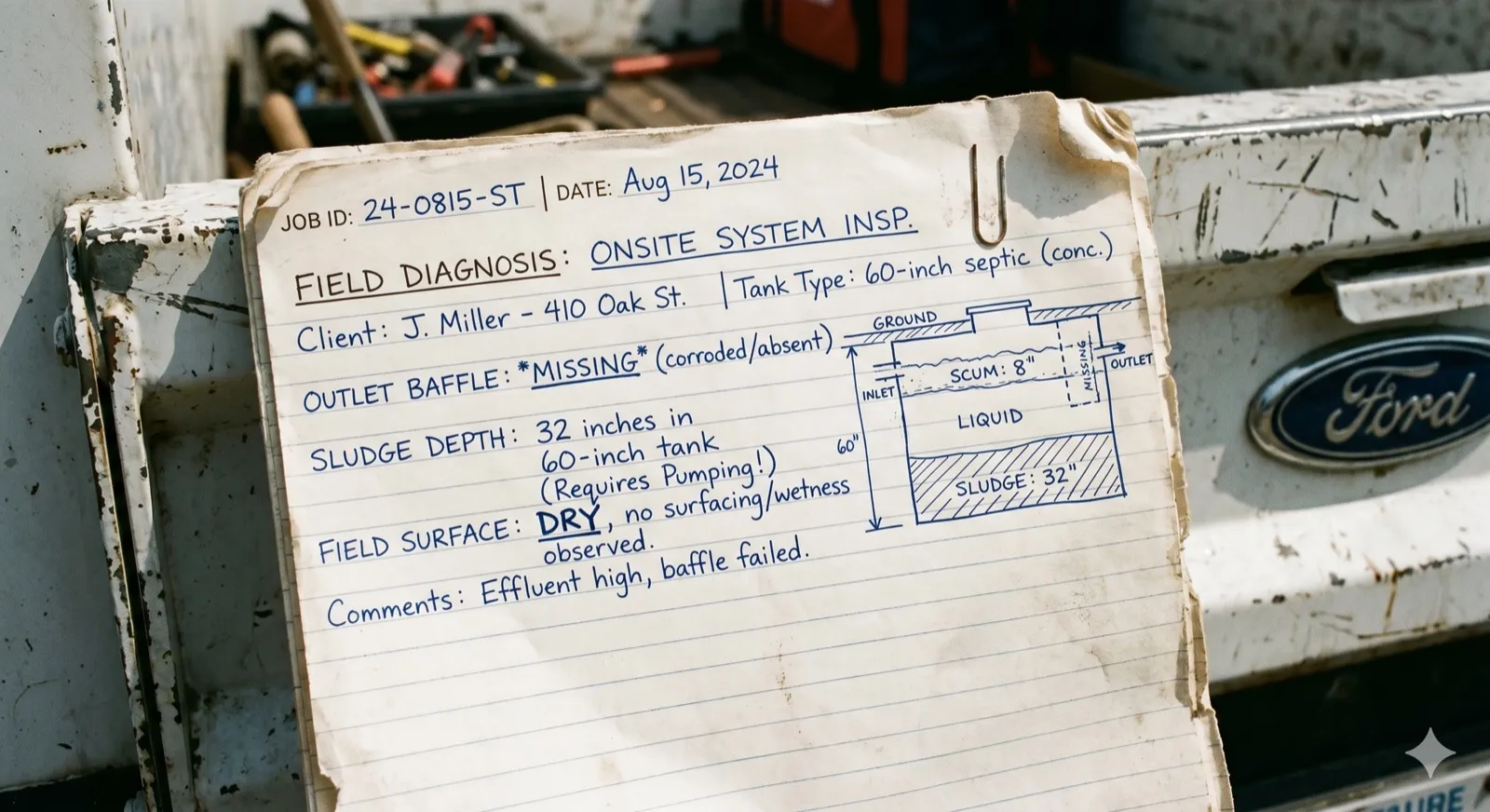
A real septic diagnosis on a Hancock County property names the failed component, the evidence that confirmed it, and a fixed-price scope for the repair. Examples:
- "Outlet baffle missing, observed via lid removal and visual inspection. Replacement quote $450 installed."
- "Distribution box settled approximately 1.5 inches at the south corner, observed via excavation. Re-leveling and re-grouting scope, $1,100 fixed-price."
- "Sludge layer depth 36 inches in a 60-inch tank, measured with sludge judge. Pump-out scope, $475."
- "Drainfield surface walked, dye test run, surfacing observed at lateral 2 within 8 minutes of dye introduction. Probable field failure pending soil scientist evaluation. Soil scientist coordination quote $500, full evaluation report 3–4 weeks."
What an upsell-pattern quote looks like instead:
- "Field treatment recommended" with no failure mechanism identified
- "Tank in critical condition" with no specific component failure observed
- "Full system replacement, $18,500, today only price"
- "Distribution box failure" with no observation method described
- Pressure to sign within hours or "we can't honor this price tomorrow"
The first set are fixable problems with bounded scopes. The second set are the patterns this guide is about.
How to get a clean second opinion
Most local Hancock County septic operators will give you a 15-minute phone consult at no charge if you describe what the first operator observed and quoted. They don't need to be on site to flag a pattern from the description. The signals they're listening for:
- Was the failure mode named (e.g., "cracked outlet baffle") or generic ("field treatment needed")?
- Is the price within local norms for that work or 3–5x the typical range?
- Did the first operator pump the tank before diagnosing replacement?
- Was a soil scientist evaluation discussed for any full-rebuild quote?
- Was there same-day pressure?
If two independent local operators agree the diagnosis is real and the price is in range, proceed. If they disagree, the upsell pattern is much more likely than the diagnosis. Listed pricing ranges for routine work are on the pricing page as a starting benchmark — anything well above those ranges should be questioned.
Got a quote that feels off?
Call (317) 836-2464. We'll walk through the diagnosis and tell you plainly whether the quote looks normal. No pressure to switch. Mon–Sat, 7 a.m.–6 p.m.
Related: sewage in your yard diagnostic · complete inspection checklist · Hancock County pricing ranges · full Hancock County septic guide