
Tank backing up after heavy rain — filter, field, or pump?
Rain-correlated backups are diagnostic — the timing tells you which component is failing. Walk through it before scheduling a service call.
Reading time: about 9 minutes · Updated May 21, 2026
A Hancock County septic system that only backs up during heavy rain is almost always one of three things: a clogged effluent filter ($50–$150 to clean), a failed distribution box or saturated drainfield ($600–$5,000 to repair, depending on cause), or a high water table that's seasonally submerging the field ($3,000–$10,000+ if a curtain drain or rebuild is needed). The diagnostic signal is the pattern — not just that it happens with rain, but how long it lasts, where backups appear, and how the system behaves after the ground dries.
- Why rain correlation is diagnostic
- Cause 1: clogged effluent filter ($50–$150)
- Cause 2: failed or clogged distribution box ($600–$1,800)
- Cause 3: drainfield saturation (varies wildly)
- How to tell which one you have
- What to do tonight if it's happening now
Why rain correlation is so diagnostic
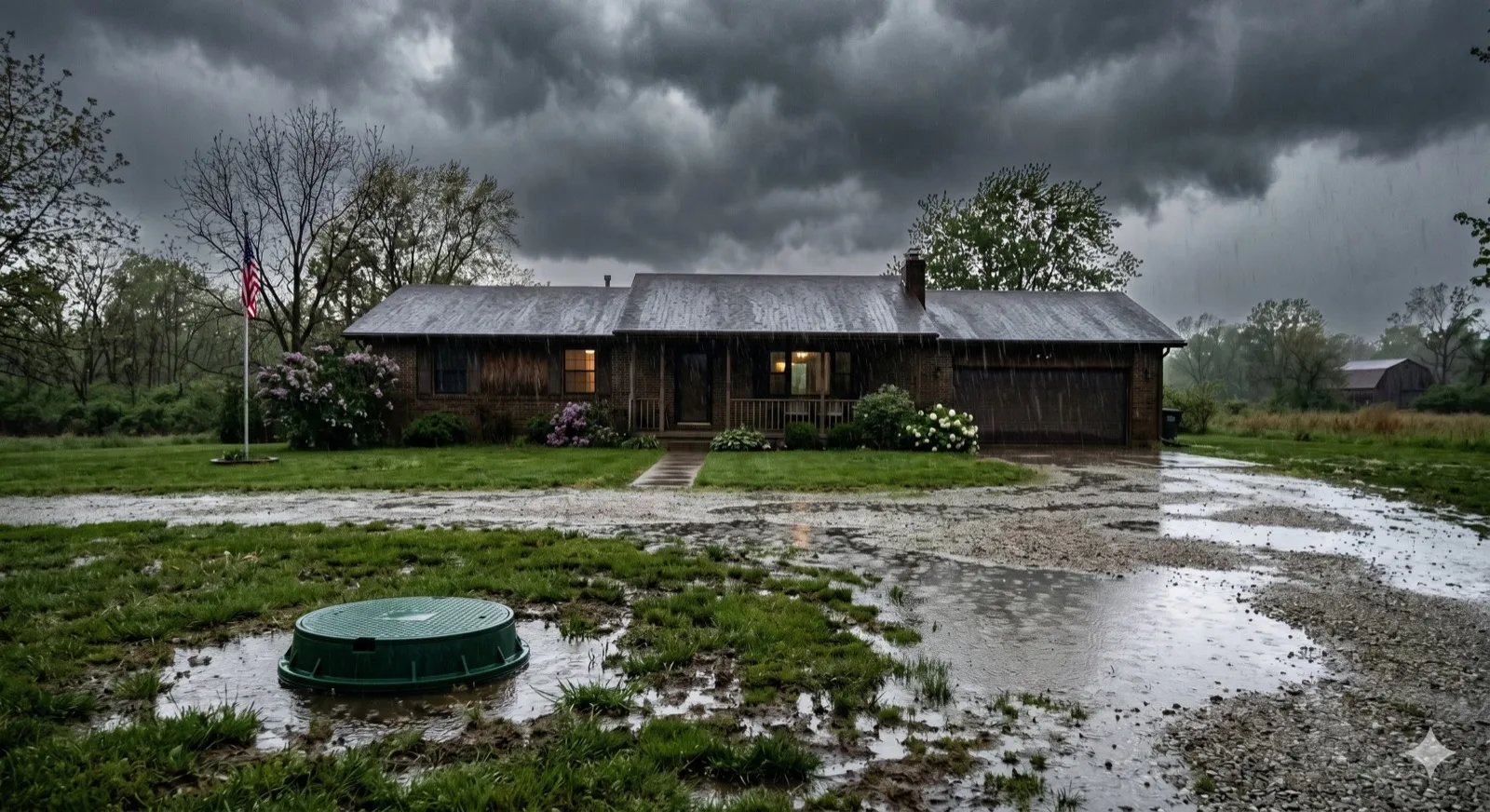
A working septic system shouldn't notice rain. The tank is watertight, the drainfield is sized to handle the household's design flow plus margin, and the soil column under the field has spare absorption capacity. When rain pushes the system over the edge — and dry days don't — something specific is wrong, and the rain is telling you what.
Three mechanisms account for nearly all rain-correlated backups: partial clogs that reduce the system's capacity to a level just below rainy-day household flow; drainfield saturation where the soil column is already at field capacity from groundwater alone; and surface water reaching the tank or D-box because lids are cracked or settled. Each shows up differently. Reading the pattern saves money.
Cause 1 — Clogged effluent filter ($50–$150)
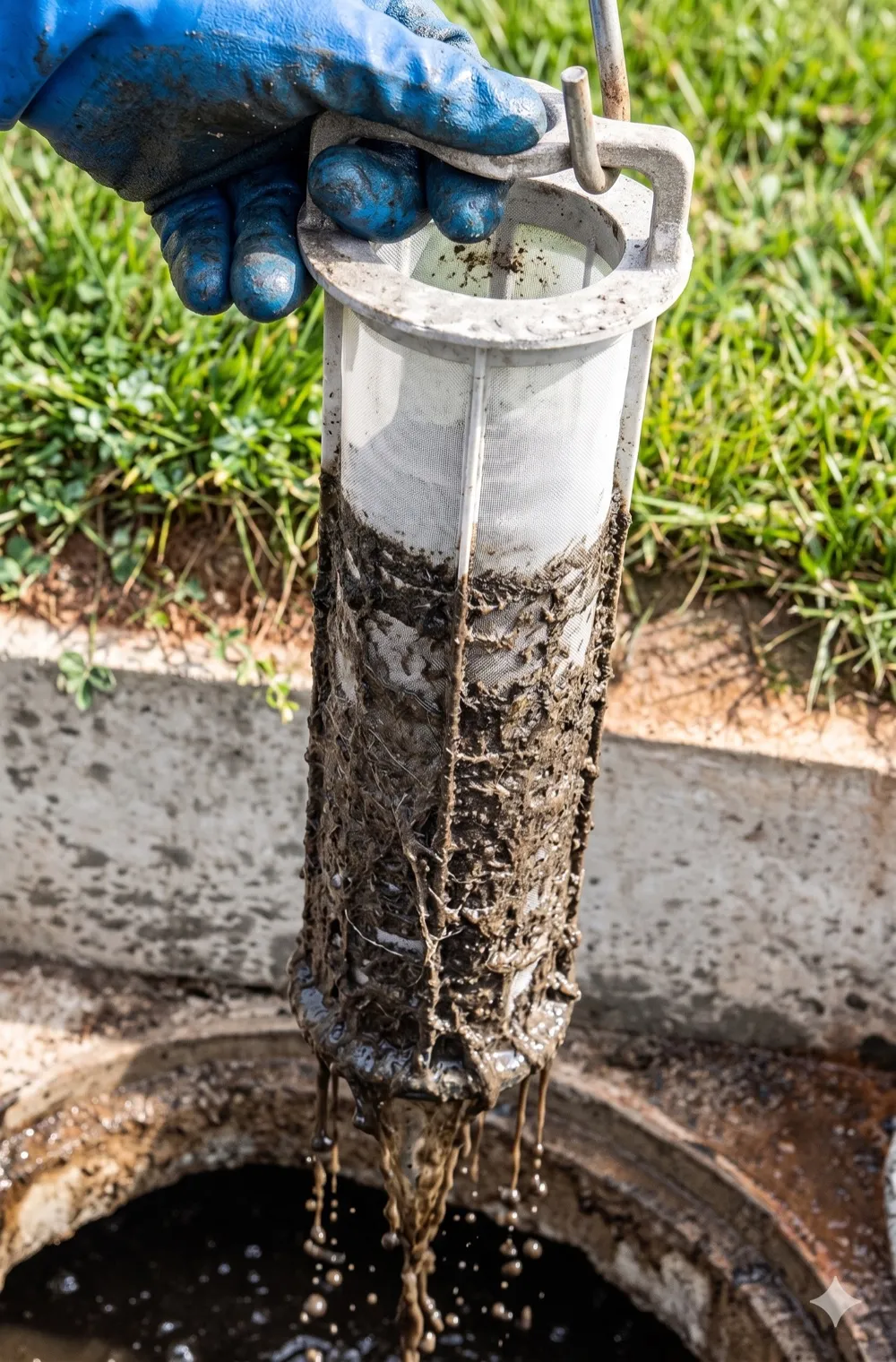
If your system was installed since roughly 2005 in Hancock County, it almost certainly has an effluent filter — a removable plastic cartridge inside the outlet baffle that catches particles before they reach the drainfield. The filter is designed to be pulled out and rinsed every 1–3 years. Most homeowners never have.
What it looks like: backups appear during or just after rain, progress through the house from the lowest fixture upward (basement floor drain first, then first-floor tub, then upstairs), and self-resolve within hours of the rain stopping. Gurgling from drains is common during the event. The system runs fine for weeks between events.
The mechanism: a partially clogged filter chokes outlet flow. In dry weather the household's typical 200–300 gallons per day still squeak through. During rain, surface water occasionally enters through riser cracks or saturated lid gaskets and pushes the tank into the flow range where the choked filter can't keep up. Backups follow.
The fix: locate the outlet baffle (sometimes labeled, often not), remove the filter cartridge, hose it off thoroughly into a bucket for proper disposal in the tank during the next pumping, and reinstall. Total cost when a pro does it is $50–$150 if combined with another visit, or $150–$250 as a standalone callout. This is one of the cheapest, most impactful preventive moves in septic ownership — and it's the first thing to check on a rain-correlated backup.
Cause 2 — Failed or clogged distribution box ($600–$1,800)
A failed distribution box overloads one drainfield lateral while starving the others. During dry weather the overloaded lateral handles the household load with margin. During rain, when the local soil column saturates faster, the overloaded lateral floods first and backs up into the tank — which then backs up into the house.
What it looks like: backups during rain, often with bright-green stripe(s) of grass over one or two laterals during dry weather (effluent fertilizing the surface). The bright stripe is the giveaway — it persists in dry months even when there's no backup.
The fix: locate, open, and inspect the D-box. Clean accumulated solids if that's the issue. Re-level the box if it has settled. Replace if the concrete has cracked through. Most repairs are $600–$1,800 and don't require a permit under 410 IAC 6-8.3 because they're maintenance, not modification. The sewage-in-your-yard guide goes deeper on the D-box pattern.
Cause 3 — Drainfield saturation (varies wildly)
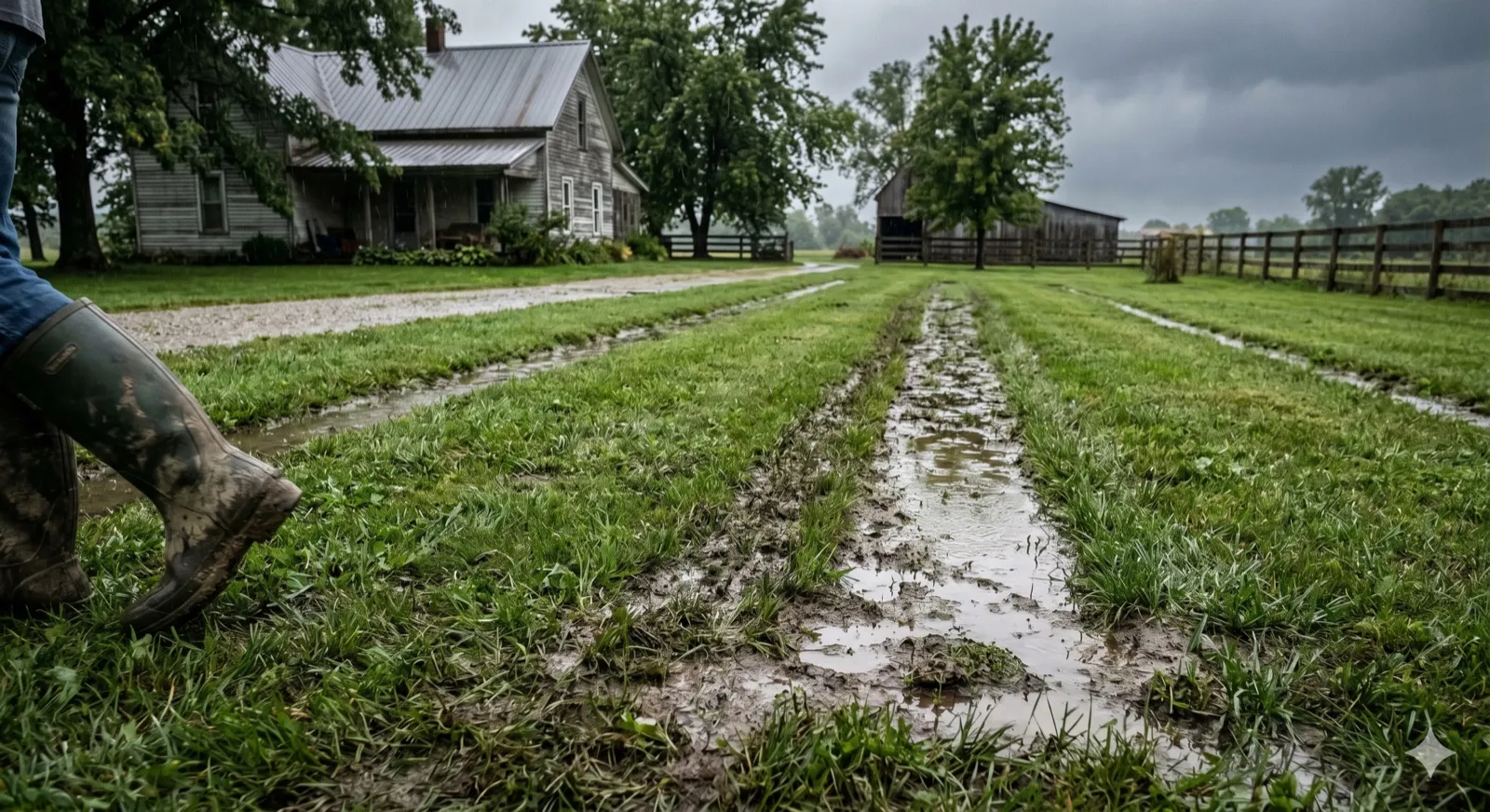
The third pattern is drainfield saturation — and this is where the biggest cost variance lives, because saturation has two causes that look identical on the surface but require very different fixes.
Sub-cause A: Hydraulic overload. The household is generating more wastewater than the field is sized for. A field designed for a three-bedroom household with two adults can be over its design capacity when six people live there — even more so during heavy laundry weeks or houseguest spikes. During dry weather the field recovers between loads; during rain, recovery time goes to zero. Fix: reduce loading. Stagger laundry, fix running toilets, spread out the dishwasher. Hydraulic overload is the most common cause of "wet field" complaints in Hancock County and the most frequently misdiagnosed as failure.
Sub-cause B: Groundwater intrusion. The water table or surface runoff is reaching the lateral trenches from outside the system. Common in Hancock County properties on low spots, near creeks (Brandywine and Sugar Creek bottoms), or downslope from neighbors who've added gutters that dump uphill. Fix: a curtain drain (~$3,000–$5,000) upslope of the field that intercepts groundwater before it reaches the trenches. The clay-soil drain field guide covers when curtain drains help.
Sub-cause C: End-of-life biomat fouling. The field is actually failing. Biomat has sealed the soil interface to the point where dry-weather recovery is incomplete; rain pushes it over the edge. Fix: full or partial drainfield rebuild ($8,000–$20,000). This is the case the upsell-heavy national chains assume by default and quote against — but it's actually the least common of the three sub-causes. Confirm before agreeing.
How to tell which one you have
Use this decision walk:
- When was the last pump-out? If it's been over 4 years, pump first. Backups during rain on a tank that's overdue are usually solved by the pump and don't repeat. ($300–$600.)
- Is the system post-2005? Likely has an effluent filter that's never been cleaned. Schedule a filter pull as a standalone or as part of the pump-out. (Add $50–$100.)
- Bright green stripe over one or two laterals during dry weather? Probably D-box. ($600–$1,800.)
- Multiple people in the house and recent change in occupancy? (New baby, relative moving in, kids back from college.) Probably hydraulic overload. Track water use for two weeks before paying anyone.
- Property at the bottom of a slope or near a creek? Probably groundwater. Walk the upslope yard during the next rain — visible runoff aimed at the field is the smoking gun.
- None of the above, system over 25 years old? Biomat fouling. Pre-rebuild, a soil scientist evaluation under 410 IAC 6-8.3 ($350–$600) is the right next spend before committing to the full project.
If none of these resolve and you're still backing up during rain, that's when a real diagnostic visit makes sense — but go in with the decision walk done first.
What to do tonight if it's happening now
If a backup is actively in progress, the order of operations:
- Stop running water. Every gallon added makes it worse. No laundry, no dishwasher, minimal flushing.
- Walk every bathroom. Lift every toilet tank lid and confirm none are running. A running flapper during a wet week can be the entire difference between a contained situation and a flooded basement.
- Note timing. When did the rain start, when did the backup start, where is it backing up (lowest fixture? toilet? floor drain?). All useful for diagnosis.
- Take photos. Of any visible surfacing in the yard, the wet pattern in the lawn over the drainfield, any sewer smells you can document, the lid area.
- Call. Most Hancock County operators can be on site within 24–48 hours for an active backup; some same-day. Routine pump and filter cleaning often resolves it without further work.
What not to do tonight: don't pour anything down the drain to "clear" it. Drain cleaners kill tank bacteria; root killers do nothing for drainfield saturation. Don't snake the line yourself unless you're certain the backup is from a single fixture (not a system-wide issue). Don't sign anything from the first operator on the scene if they're quoting $15,000+ without a written component-level diagnosis — see the upsell-scams guide.
Wet-season backup in Hancock County?
Call (317) 836-2464. We'll talk through the pattern before anyone schedules a truck. Mon–Sat, 7 a.m.–6 p.m.
Related: sewage in your yard diagnostic · soggy yard in clay soil · full Hancock County septic guide