
What a complete Indiana septic inspection should cover before you sign
Most Indiana septic problems found post-close were findable pre-close — by an inspection that did the actual work. Here's what to demand and what to refuse.
Reading time: about 12 minutes · Updated May 21, 2026
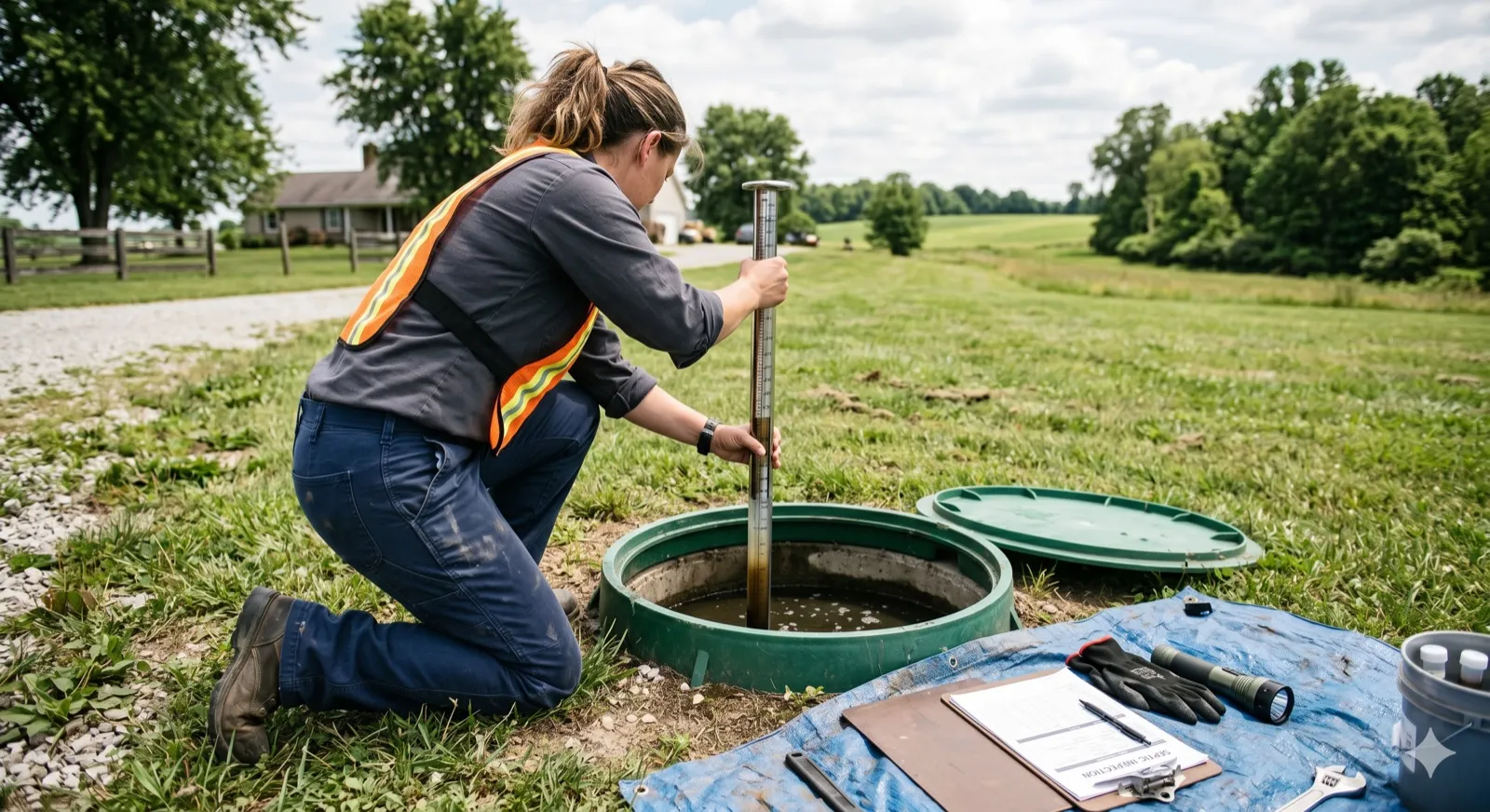
A complete Indiana septic inspection includes: physically opening the tank and visually inspecting the interior, baffles, and walls; pumping the tank if the inspection scope warrants it; running a flow test from inside the house to verify the system accepts water; walking and probing the drain field for surface evidence and soil saturation; and producing a written report with photographs and a clear pass-fail conclusion. Records-only inspections — the kind that skip opening the tank and rely on prior service receipts — are the single most common source of missed defects in Hancock County real estate transactions. Insist on the physical inspection scope, in writing, before you sign the inspection contingency.
- Why this matters more than most pre-purchase items
- What Indiana's 410 IAC 6-8.3 actually requires (and doesn't)
- The complete-inspection checklist (12 items)
- Red flags in the inspector or report
- FOIA-ing permit records from the Hancock County Health Department
- What to do when the report finds problems
Why this matters more than most pre-purchase items
A failing septic system is one of the few residential defects that can hit $20,000+ in unanticipated repair costs and cannot be deferred — once the field gives out, the house becomes practically uninhabitable until it's fixed. Unlike a roof or HVAC system that gives years of warning, a borderline drainfield can pass a casual walkthrough and fail completely within months of closing. The inspection is your last chance to find this on the seller's dime rather than yours.
Indiana's housing market has a specific signature here: a meaningful share of pre-1990 rural homes in Hancock County still have their original septic systems, well past the 25-to-30-year design life of a typical drainfield. The most common buyer-side story is closing on a "move-in ready" home and discovering within six months that the field is at end of life. A real inspection prevents this; a records-only review does not.
What 410 IAC 6-8.3 actually requires (and doesn't)
Indiana's septic code (Title 410, Article 6, Rule 8.3 of the Indiana Administrative Code) governs system design and installation — soil scientist evaluations, tank sizing, drain field sizing, setbacks. It does not mandate a specific inspection format for real estate transactions. There's no state-defined "Indiana Septic Inspection Standard" the way some states have. That means the inspection scope is whatever the inspector and the buyer's agent agree to in the contract — which is exactly where corners get cut.
Hancock County's Environmental Health Division enforces 410 IAC 6-8.3 for new installs and modifications, but it does not certify inspectors or audit inspection reports. The lender, the buyer's agent, and the buyer themselves are the only quality control on what gets inspected. Knowing this is the first defense.
The complete-inspection checklist
Insist on every item on this list, in writing, as the inspection scope before the inspector arrives. If any are missing from the scope quote, ask why. The most common reason is "we don't usually include that" — which is a polite way of saying "the cheap version doesn't catch this."
- Tank location and access. The inspector physically locates and uncovers the tank lids — not just notes that "the tank is in the back yard somewhere." Untraceable tanks during inspection have become deal-killers; locate first.
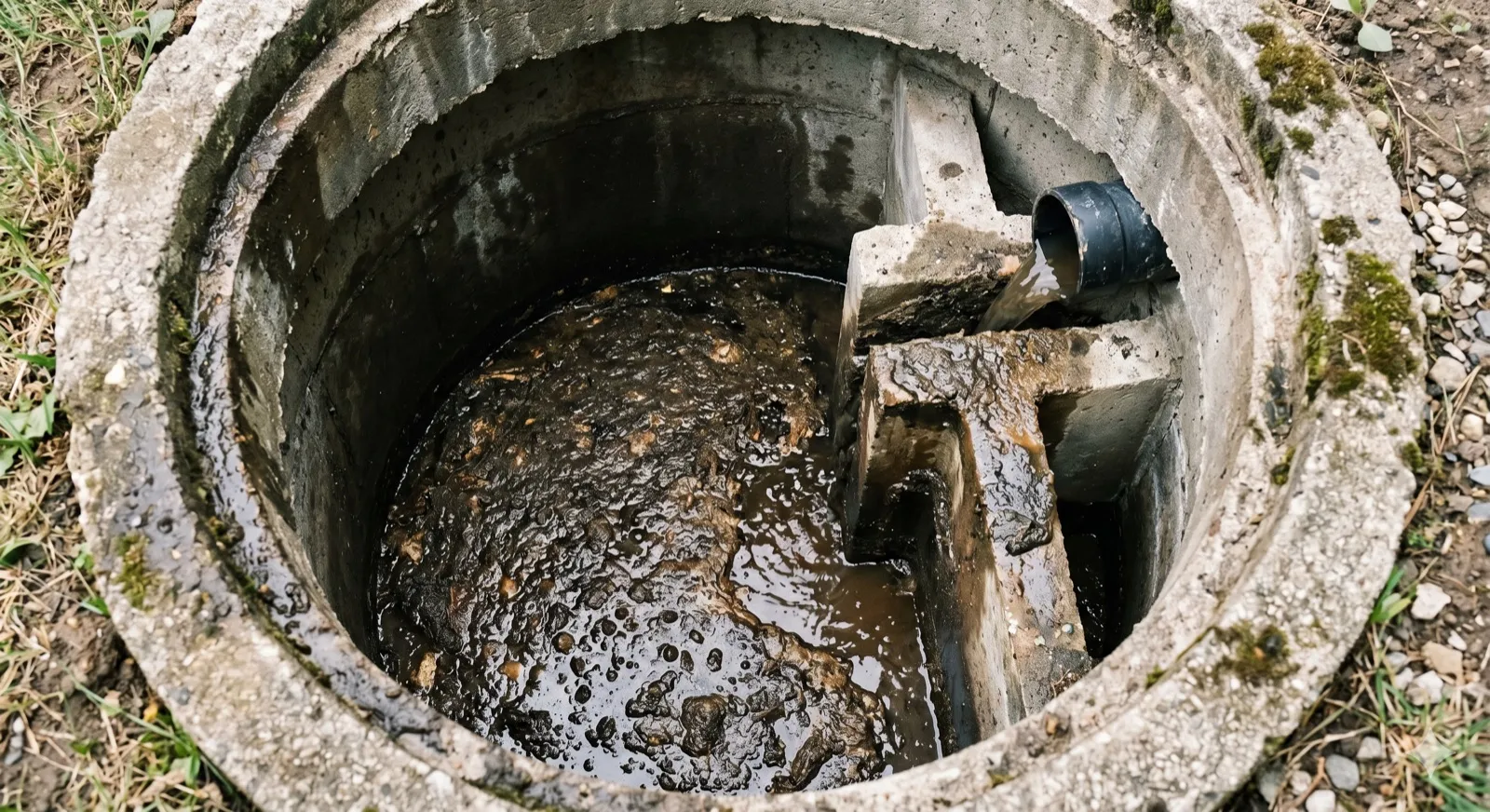
- Open the tank. Lid comes off, interior is visually inspected. Sludge layer depth is measured (a "sludge judge" stick is standard equipment). Scum layer depth is noted. Inlet and outlet baffles are observed.
- Tank structural condition. Walls inspected for cracks, corrosion, and settling. Steel tanks (common in pre-1980 Hancock County homes) are specifically checked for rust-through at the waterline — a known failure mode that records won't show.
- Baffle condition. Both inlet and outlet baffles confirmed present and intact. A missing outlet baffle (common in older systems) sends solids straight to the drain field, accelerating failure — this is one of the most consequential silent defects.
- Riser and lid integrity. Riser stack inspected for cracks, lid for proper seal, gasket condition noted. A cracked riser is a child safety hazard and lets surface water into the tank, shortcutting the pumping cycle.
- Flow test from inside the house. Water run from multiple fixtures simultaneously (typically 100–150 gallons over 30 minutes) while the inspector watches the tank fill behavior and the drain field for surface response. This is the test that catches a marginal drainfield.
- Drainfield surface walk. The full field is walked, including probing soft spots. Bright-green stripes, depressions, smells, and surface saturation are noted with photographs.
- Distribution box check (if accessible). If the D-box is identifiable, it's opened and inspected for level, clog, and flow distribution. This is sometimes deferred if the box isn't surface-accessible, but should be flagged in the report when skipped.
- Building sewer line scope (optional but recommended). A camera scope from the cleanout to the tank confirms the line is intact and the run matches what the records claim. This is where the worst surprises hide — unpermitted graywater pits, bootlegged routing, abandoned tanks still in the run.
- Dye test (situational). If the inspector suspects illegal effluent routing or wants to verify drainfield function under load, dye-test water is run through the system and the surface is monitored for color appearance at unexpected locations.
- Permit records review. The inspector pulls or asks the buyer to pull permit history from the Hancock County Health Department — installation permit, any repair permits, septic-to-sewer conversion records if relevant.
- Written report with photographs. Within 2–3 business days. Photos of every significant component, sludge depth measurement, pass-fail conclusion, and any recommended follow-up work with rough cost ranges.
Red flags in the inspector or report
A records-only inspection — sometimes called a "paper inspection" — is one where the inspector reviews prior service records, walks the yard briefly, and signs off. No lids come off. No flow test runs. No actual interior view of the tank. This is the most common form of inspection in cost-conscious markets and the single biggest cause of missed defects. Refuse it.
Specific red flags in the written report:
- No sludge depth measurement. Means the tank probably wasn't opened, or wasn't opened with the right tool. A real inspection always includes this number.
- No photographs of tank interior. Same issue — confirms the lid wasn't off.
- "Drain field appears functional" with no flow test. Appears functional in dry weather doesn't mean accepts load. The whole point of a flow test is to load the field while watching.
- No baffle condition statement. Missing outlet baffles are common and consequential — a complete report names both.
- A blanket "pass" with no component-level findings. Even a perfectly functional system has component-level notes (e.g., "outlet baffle intact, no corrosion observed"). Bare "pass" is incomplete.
- No permit history reference. The inspector should at least note whether they reviewed county records, even if they found nothing.
If the report has any of these, ask the inspector for the missing items in writing, or hire a second inspection — better to pay $400 twice than miss a $15,000 problem.
FOIA-ing permit records from the Hancock County Health Department
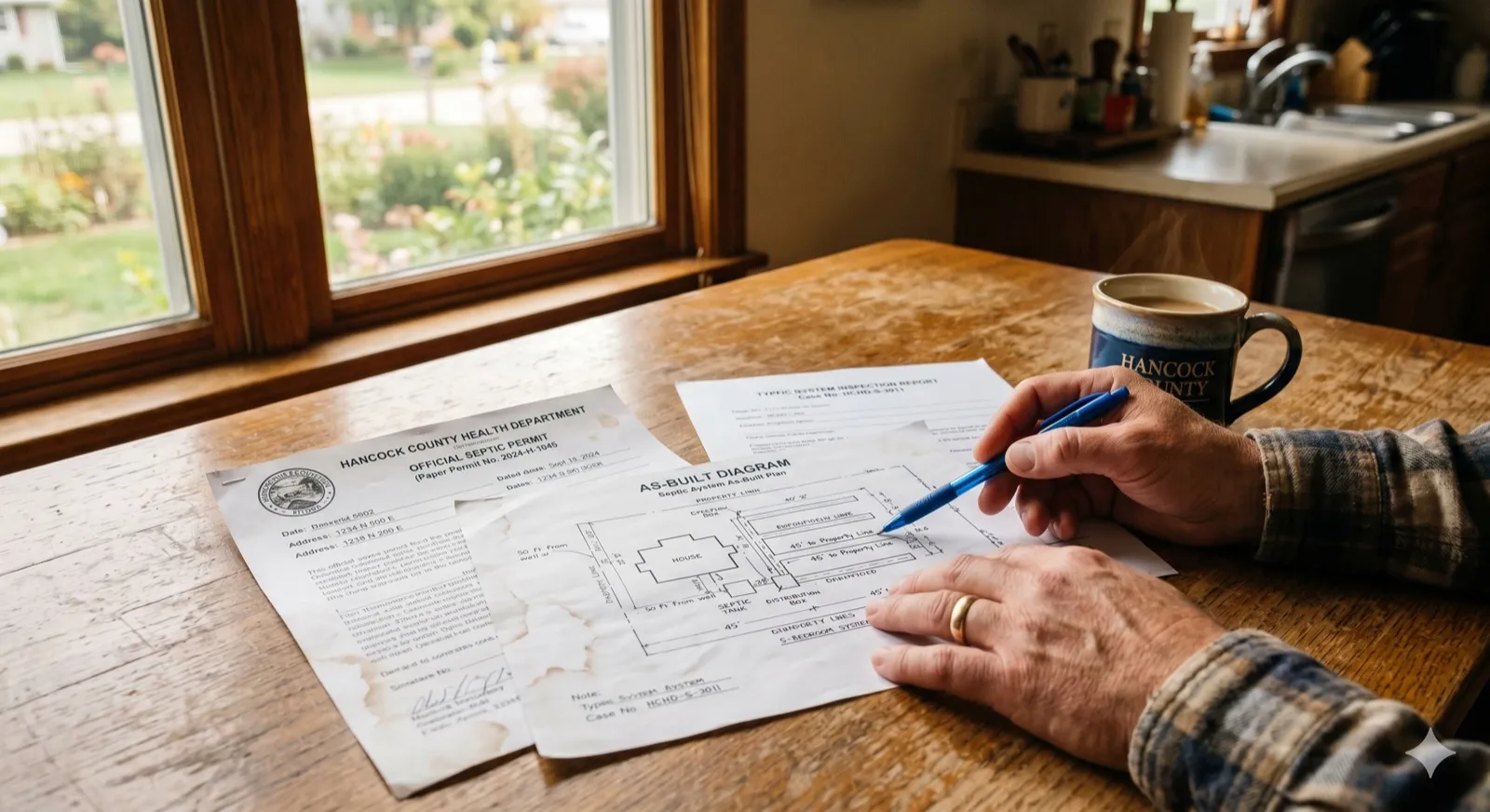
Every septic install, replacement, and major modification in Hancock County is documented in the Environmental Health Division's permit records. Buyers can request these directly — you don't need to wait for the inspector to do it, and pulling them yourself sometimes reveals information the seller hasn't disclosed.
What you can request, by property address:
- Original installation permit (if the system was installed after 1985, when modern recordkeeping started in earnest)
- As-built drawings showing tank and drainfield location
- Soil scientist evaluation report (required for any installation under 410 IAC 6-8.3)
- Any subsequent repair or modification permits
- Septic-to-sewer conversion records, if the property was ever connected to municipal sewer
- Any complaints or violations on file
The Hancock County Health Department permits line is (317) 477-1127, with walk-in hours weekday mornings from 8 to 10 a.m. at 111 American Legion Place in Greenfield. Request the records in writing (email is fine) and reference the parcel number — that's faster than address-only searches. Standard turnaround is a few business days.
For systems older than 1985 or installed by an unlicensed contractor (more common than buyers realize), county records may be incomplete. The Indiana State Department of Health holds some additional records; their public records request process is online. Either way, the absence of records is itself information — a system with no paper trail is a system whose age, design, and installer cannot be verified, and that's a real disclosure issue at closing.
What to do when the report finds problems
A failed inspection isn't usually a deal-killer in central Indiana — most transactions with septic findings still close on schedule. The common outcomes:
- Seller repairs before closing. Cleanest path when the repair scope is bounded and timeline allows. Get the repair quote in writing from a licensed contractor; verify completion before signing.
- Price credit at closing. Seller credits buyer the repair cost (often plus a contingency margin) and the buyer handles the work post-close. Useful when the repair is larger or when timing is tight.
- Closing escrow holdback. A portion of the purchase price is held in escrow until the repair is documented complete. Lender-friendly for FHA and USDA transactions.
- Walk away. Reserved for cases where the system needs full replacement and the seller refuses to address it. Rare but real — and it's why you have a contingency.
One specific scenario worth flagging: if the inspection reveals unpermitted work — bootlegged graywater pits, illegal effluent discharge, or a system installed without county records — that's a disclosure issue, not just a repair issue. Indiana law requires sellers to disclose known defects; an unpermitted septic is a known defect by definition. Get your real estate attorney involved before accepting any settlement.
Closing on a Hancock County home with septic?
Call (317) 836-2464 to schedule a full real estate septic inspection. On site in 60–90 minutes, written report in 2–3 business days.
Related: how long does a septic tank last · spotting septic upsell scams · full Hancock County septic guide