
How long does a septic tank last? A Hancock County buyer's checklist
Tank lifespan depends mostly on material, secondarily on usage. Here's what each type gives you, what Hancock County housing stock looks like, and how to assess age before you close.
Reading time: about 11 minutes · Updated May 21, 2026
Septic tank lifespan in Hancock County, Indiana ranges from 20 to 50+ years depending on tank material. Concrete tanks (the standard for installs since the 1970s) typically last 25–40 years. Steel tanks (common pre-1980) last 20–30 years before rust-through and are the most common silent failure in older homes. Fiberglass and polyethylene tanks (occasional in newer installs) last 30–50+ years. Drainfields last 20–30 years regardless of tank material — typically the shorter-lived component. For buyers: tank age plus drainfield age, not tank age alone, is the right replacement-cost variable, and the inspection checklist below is how to assess both.
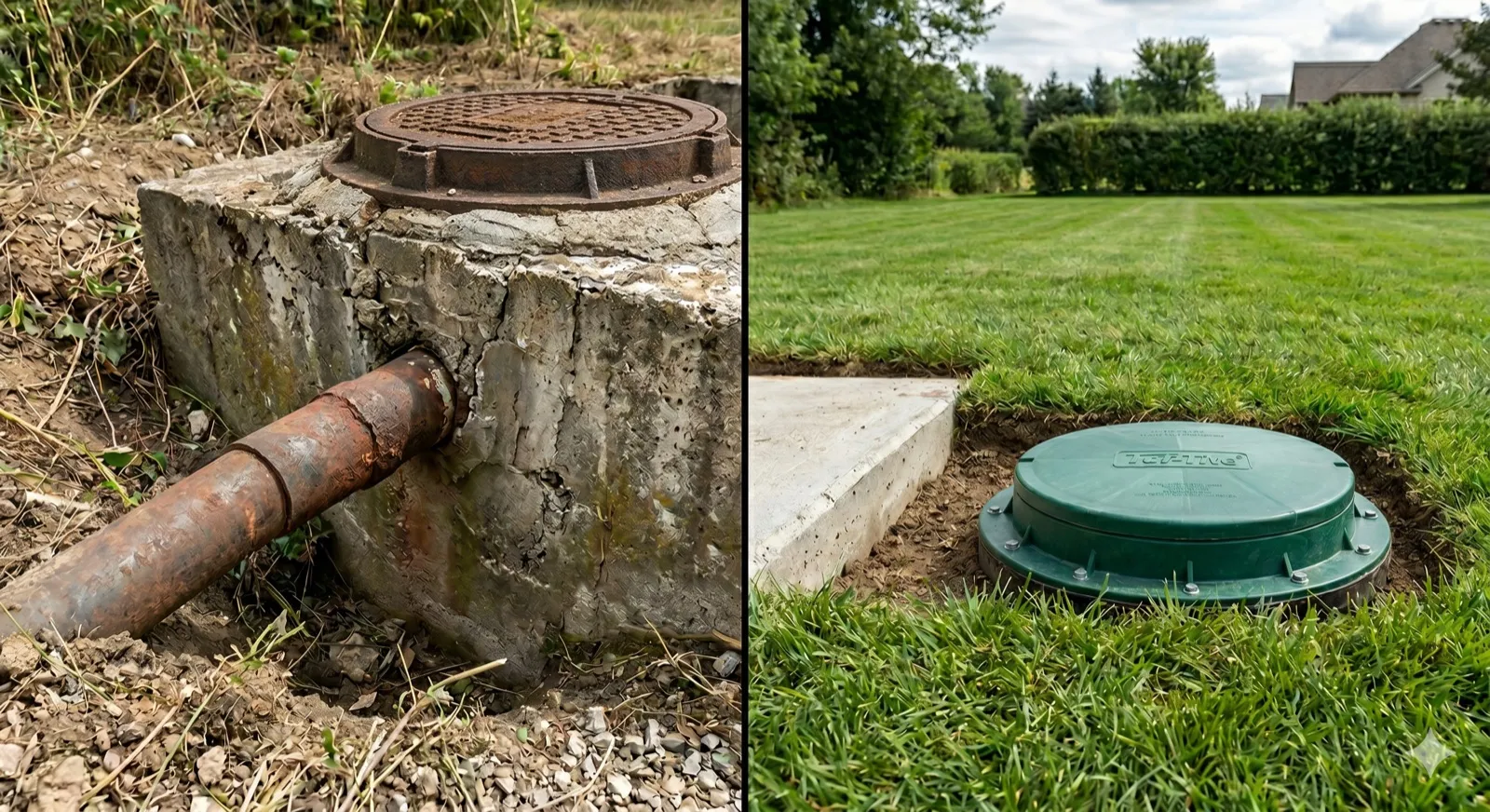
- Lifespan by tank material (concrete, steel, fiberglass, cesspool)
- Hancock County housing-stock context by era
- Drainfield lifespan — usually the limiting factor
- Buyer's checklist for assessing tank age and condition
- Save-vs-replace trigger points
- Notes for sellers
Lifespan by tank material
The dominant variable in tank lifespan is what it's made of. Indiana's installer licensing rules under 410 IAC 6-8.3 cover tank quality standards but allow multiple materials.
Concrete (~25–40 years)
The default for residential installations in Hancock County since roughly the early 1970s and still the standard today. Heavy, durable, and structurally sound under normal soil loads. Modern concrete tanks with proper seal joints and access risers comfortably hit 30+ years; older concrete tanks (1970s) often show seam separation and waterline corrosion in the 25–35 year window. The most common failure mode is cracked sidewall allowing groundwater intrusion (which then floods the drainfield) or a deteriorated outlet baffle (which sends solids to the field).
Steel (~20–30 years, often less)
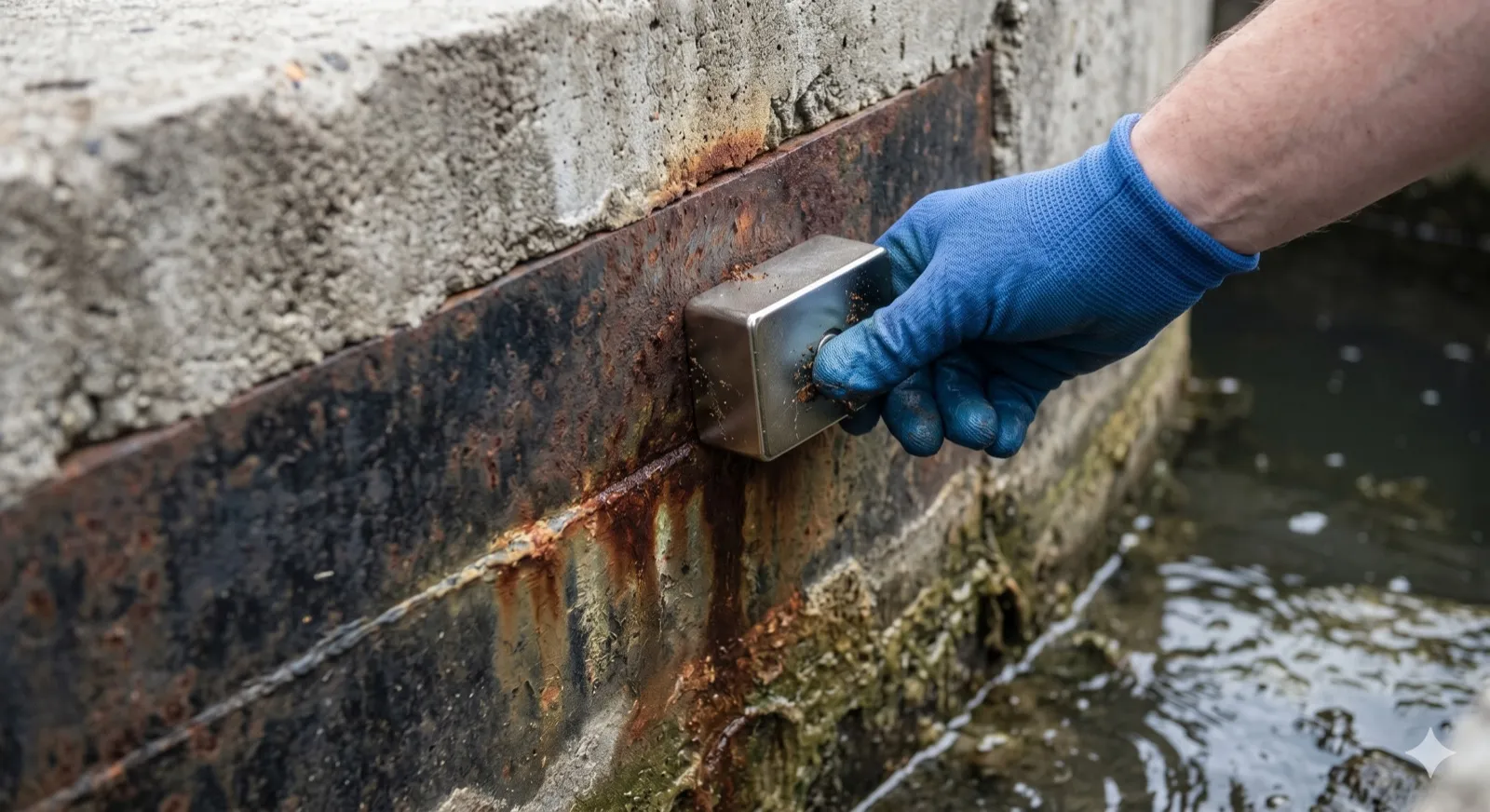
Common in Hancock County installations from the late 1950s through the 1970s. Cheap to manufacture and install at the time but rust-prone. Steel tanks corrode from the inside at the waterline — the boundary between effluent and air is where oxygen and moisture combine to attack the metal. A 25-year-old steel tank often has thin metal at the waterline that can perforate or collapse without obvious external warning. This is the most common silent failure in Hancock County's 1960s and 1970s housing stock, and it's a known driver of late-in-life septic surprises.
Fiberglass / polyethylene (~30–50+ years)
Less common in Hancock County but increasingly used in difficult installs (high water table, restricted access). Highly corrosion resistant and structurally durable when properly installed. Main risks are buoyancy (tank floating during pumping if not ballasted properly) and structural deformation from poor backfill. When installed correctly they often outlast the house's first drainfield.
Cesspools / dry wells (variable, often illegal now)
Pre-1970s installations in rural Hancock County sometimes used cesspools (a pit with permeable walls) or seepage pits instead of true septic tanks. These don't meet current 410 IAC 6-8.3 standards and are progressively being phased out as homes change hands. A property with a cesspool will typically require a full tank-and-field install before resale, regardless of "lifespan" — code compliance, not tank condition, is the driver.
Hancock County housing-stock context
Knowing the era of the house tells you most of what you need to know about the original tank. Hancock County's rural housing stock breaks into rough eras:
- Pre-1960: Farmhouse-era construction across the rural townships. Original waste systems were often cesspools or seepage pits rather than true septic tanks. Almost all of these have been replaced at least once; if records suggest the original is still in service, that's a major buyer flag.
- 1960s–1970s: Steel tanks dominant. If the home was built in this era and the tank has never been replaced, it's at or past steel's design life and rust-through is the leading concern.
- 1980s–1990s: Concrete tanks became standard. Tanks from this era are now 30–40 years old — well into the back half of their service life and worth evaluating closely before purchase.
- 2000s onward: Modern concrete tanks with effluent filters, gasketed risers, and updated baffle designs. Original tanks should have decades of service remaining barring installation defects.
Specific Hancock County contexts: Fortville's older neighborhoods inside the town footprint, the original homes along CR 200N and CR 200W, the 1970s ranch homes in rural Vernon Township, and the pre-buildout Mt. Comfort area all skew older. The newer McCordsville subdivisions, Pendleton residential growth, and the New Palestine school-district expansion are mostly post-1995 concrete installs.
Drainfield lifespan — usually the limiting factor
In most Hancock County homes, the drainfield reaches end of life before the tank does. Conventional gravity drainfields are designed for 20–30 years of service. Use, maintenance history, household size relative to design, and soil conditions all affect actual lifespan, but the design assumption is roughly a generation.
The mechanism is biomat fouling — a layer of anaerobic bacteria that builds up at the soil interface where the lateral pipes leak effluent into the gravel. A thin biomat is useful (it filters effluent before soil absorption). A thick mature biomat seals the soil interface and the field stops absorbing. When that happens the field surface saturates and the system backs up.
For a buyer, this means a 30-year-old tank with a 30-year-old original field is a candidate for replacement on field age alone, even if the tank looks fine. The replacement cost is the larger number — $8,000–$20,000 for a full drainfield rebuild versus $5,000–$10,000 for a tank-only swap. Tank age tells you part of the picture; field age tells you most of it.
Buyer's checklist for assessing tank age and condition
Before signing, work through:
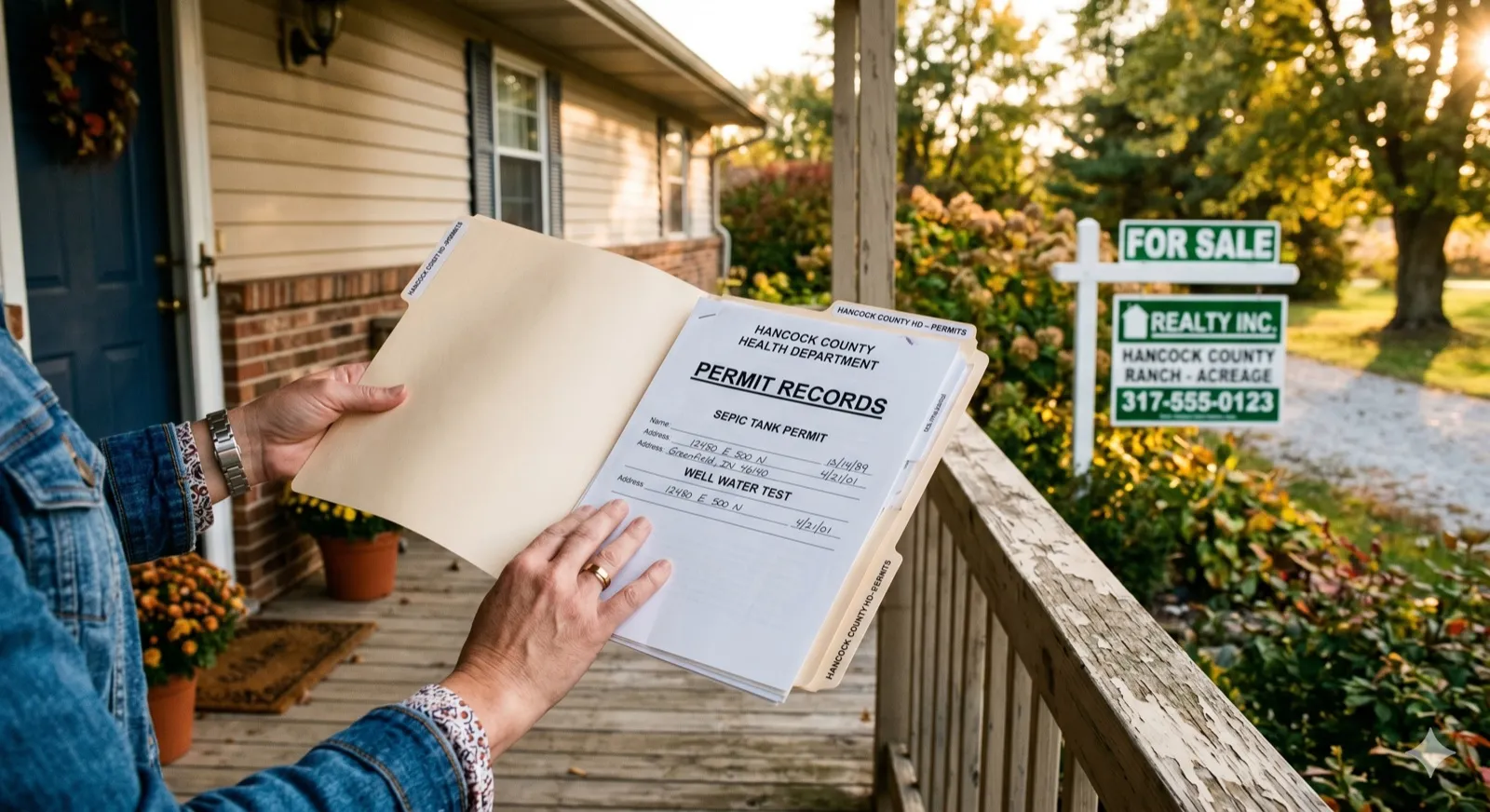
- Pull the permit records. Hancock County Environmental Health Division at (317) 477-1127 has installation permits on file from the mid-1980s onward. The permit tells you exact install date, contractor, tank material, and tank size — the most authoritative source. The inspection checklist guide covers the FOIA process.
- Ask the seller for service records. Pump-out receipts, repair invoices, and inspection reports going back as far as the seller has them. Records older than the seller's ownership are usually lost; what they have is what they have.
- Run the magnet test on the tank lid. Concrete tanks shouldn't be magnetic; rusting steel will pull a magnet. This is a 10-second test that immediately tells you tank material if records are missing.
- Inspect the tank interior. Part of any full inspection — the inspector pulls the lid and looks. Sidewalls, baffles, waterline condition, signs of groundwater intrusion are all observable. Photographs should be included in the written report.
- Note the drainfield age separately. Original drainfield from install date, or replaced/repaired since? Replacement permits would also be in county records.
- Estimate remaining service life. Tank material lifespan minus current age gives a starting estimate. Add condition observations to refine. Subtract years aggressively if the system has been under-maintained (long pump-out gaps, missing baffles, no riser).
- Calculate the worst-case replacement cost. Tank replacement: $5,000–$10,000. Full drainfield rebuild: $8,000–$20,000. Both together: $13,000–$30,000 with permits. Build this into your offer.
Save-vs-replace trigger points
Most Hancock County tanks worth saving show:
- Concrete construction, structurally intact, no visible cracks through which groundwater enters
- Both inlet and outlet baffles present and functional
- Riser intact or replaceable (riser replacement is cheap)
- Walls show normal weathering but no rebar exposure or spalling
- Documented or estimated install date within the past 30 years
Tanks at the replacement decision point typically show one or more of:
- Steel construction at 25+ years (rust-through risk)
- Concrete construction at 40+ years with visible seam separation or spalling
- Multiple cracked or missing baffles
- Groundwater entering the tank (visible water rise after pumping that doesn't track with household input)
- Insufficient capacity for current household size — a 750-gallon tank serving a five-person home wasn't sized for the load
- Cesspool or dry well configurations that don't meet current code
Most condition-driven replacements in Hancock County come with tank-and-field combined work because the drainfield is usually due at the same time. Plan and budget that way; a tank-only quote that ignores the field is usually short-term thinking.
Notes for sellers
If you're selling a Hancock County home with a tank that's approaching end of life, the inspection is going to find it. Three approaches:
- Get ahead of it. Pump and inspect before listing ($300–$600). The report becomes a disclosure tool — if the system is fine, the report sells confidence; if it's marginal, you know the buyer-side conversation before it happens.
- Price for it. Adjust the list price to reflect the expected repair or replacement scope. Cleaner than negotiating a credit at the inspection contingency, and removes the surprise factor.
- Replace before listing. Rarely worth it economically — buyers typically don't pay full replacement value for new systems — but it can shorten the sale timeline and remove inspection-driven deals from the table.
What sellers should not do: cover up known defects. Indiana law requires disclosure of known material defects in residential transactions, and a septic system that the seller knows is failing is a material defect. Failure to disclose can void the sale and create post-close legal liability that vastly exceeds whatever was being concealed.
Buying or selling a Hancock County home with an older septic?
Call (317) 836-2464 for a real estate septic inspection. Full report in 2–3 business days. Mon–Sat, 7 a.m.–6 p.m.
Related: complete inspection checklist · spotting upsell scams · full Hancock County septic guide